The Metropolitan Museum of Art, Open Access · CC0 / The Met Open Access
The Unicorn Rests in a Garden: Look Before You Interpret
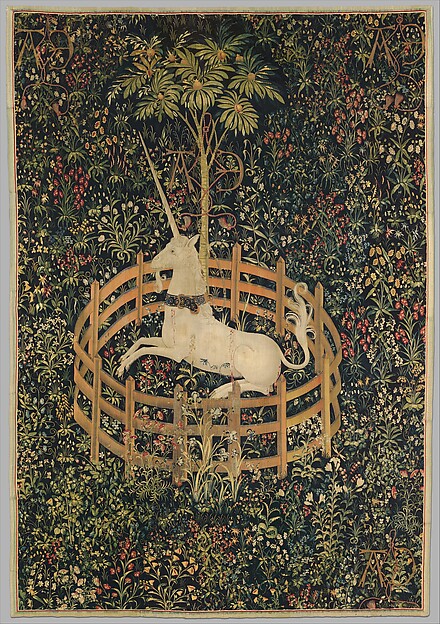
Follow the collar, chain, pomegranate tree, and fence in The Unicorn Rests in a Garden, separating visible evidence from possible meaning.
Reviewed and updated
- Museum title
- The Unicorn Rests in a Garden (from the Unicorn Tapestries)
- Date
- 1495–1505
- Materials
- Wool warp; wool, silk, silver, and gilt wefts
- Dimensions
- Approximately 368 × 251.5 cm
- Collection
- The Metropolitan Museum of Art
The Metropolitan Museum of Art currently titles this hanging The Unicorn Rests in a Garden (from the Unicorn Tapestries). Many readers know the same image as The Unicorn in Captivity. The difference is useful: “captivity” begins interpreting the scene before we have looked closely at how its separate parts work.
The image shows a unicorn wearing a decorated collar. A chain rises from that collar towards the pomegranate tree behind it. A low fence surrounds the garden, but the chain does not lead to the fence. Keeping the tree, chain, and fence separate gives us a firmer basis for asking what the enclosure may mean.
This guide uses three simple labels:
- Evidence: a detail visible in the documentary image or stated in the museum record.
- Inference: a possible visual effect or meaning supported by those details.
- Unknown: something the image and record do not settle.
That method does not remove the mystery. It prevents an attractive interpretation from quietly becoming a fact.
Begin with the museum record
The Met dates the tapestry to 1495–1505 and records a wool warp with wool, silk, silver, and gilt wefts. It measures approximately 368 by 251.5 centimetres—far larger than a laptop or phone screen suggests. The museum describes the culture as “French (cartoon)/South Netherlandish (woven)” and records the work as a 1937 gift from John D. Rockefeller Jr.
Those facts establish the object, but they do not supply a key to every flower, mark, or gesture. A collection record can document title, materials, dimensions, and history while leaving the image open to competing interpretations.
The title also deserves care. This article retains The Unicorn in Captivity as a familiar alternative because readers will encounter it in books, product descriptions, and older discussions. For the object itself, however, it follows the institution’s current title.
What is visible before interpretation begins?
The pale unicorn occupies the centre of a dark, densely planted field. It rests beneath a fruiting pomegranate tree. A decorated band circles its neck. From that area, a chain curves upward towards the tree and appears to wind around its trunk. The represented fastening is not connected to the surrounding fence.
The fence forms a separate ring around the garden. It is low relative to the unicorn, with plants growing inside and around its rails. Red marks appear on the animal’s coat, while red fruit and flowers are distributed through the composition. The animal is still rather than shown pulling against the tether.
These are observations. Words such as willing, protected, possessed, defeated, or resurrected belong to a later stage. They may be worth testing, but the image does not label any of them as its answer.
Follow the chain, not the idea of captivity
Start at the collar and trace the chain upward. In the museum image, it curves towards the pomegranate tree and appears to pass around the trunk. Its route is distinct from the horizontal and curving rails of the fence.
That correction matters because prose can become a misleading diagram. Saying that the chain attaches the unicorn “to the enclosure or tree” merges two visual structures. A more accurate description is:
A chain rises from the unicorn’s collar towards the pomegranate tree inside a separately fenced garden.
The chain appears slack rather than pulled into a straight line under visible tension. We can describe the effect: attachment is present, but active struggle is not. We cannot determine from that appearance alone why the line was represented this way or how a real tether would function.
The woven image is not a stable-management diagram. It cannot establish the chain’s real-world strength, exact material, or ability to restrain an animal. Nor does apparent slack prove that the unicorn “chooses” captivity. That is an interpretation, not a measurement.
Keep the fence in its own column
The fence makes enclosure immediately legible. Its circular form repeats around the unicorn and garden, while the vertical posts interrupt the flowered field. Yet it does a different job from the chain.
The chain connects the animal visually to the tree. The fence marks the boundary of a planted space. Together they intensify the question of containment, but they should not be treated as one device.
| Element | Evidence in the image | Possible inference | What remains unknown |
|---|---|---|---|
| Collar | A decorated band surrounds the unicorn’s neck. | The animal is marked as attached or controlled. | Its exact represented construction and historical type. |
| Chain | A curved line rises from the collar towards and around the tree. | Attachment is visible without a scene of pulling or struggle. | Why it appears slack and what meaning the makers or patrons assigned to it. |
| Pomegranate tree | A fruiting tree rises directly behind the unicorn; the chain leads towards its trunk. | The tree organises the composition as well as receiving the tether-like line. | Which symbolic associations were intended here. |
| Fence | A low fence encircles the unicorn and planted ground. | It makes the garden read as an enclosure. | Whether viewers were meant to understand a literal pen, an emblematic boundary, or both. |
The table is deliberately uneven. Evidence can be specific; interpretation often has to remain conditional.
Look at the tree as structure before symbol
Pomegranates have accumulated many religious and courtly associations, and it is tempting to choose one as the solution. Before doing that, look at what the tree physically does in the composition.
Its trunk rises through the centre of the image behind the unicorn. Its branches spread across the upper field. Fruit creates repeated warm points against the dark foliage. The chain’s route draws attention back to the trunk. The tree therefore works first as an organising structure: it joins the animal, upper garden, and tether-like line.
Only after describing that structure should a reader investigate symbolic interpretations. Any claim about fertility, marriage, suffering, renewal, unity, or religious meaning needs a source tied to this object and its historical context. A dictionary definition of “pomegranate symbolism” is not enough to prove what this particular tapestry meant.
Red marks: name the visual echo without solving it
Red marks are visible on the unicorn’s pale body. Elsewhere, red appears in fruit and flowers. The repetition creates a visual relationship whether or not every red form carries the same meaning.
When the garden hanging is placed after scenes of attack and death, the marks can be read as injuries. Their proximity in colour to split or ripening pomegranates can invite another association. But sequence itself is part of the problem: the surviving hangings do not provide perfectly documented instructions for one original arrangement.
A careful description therefore stops short of declaring the marks to be blood, juice, or a deliberate fusion of both. It records the colour echo and then identifies the interpretation as a possibility.
Is this the final scene of the Hunt?
Modern presentations commonly place the garden image at the end of the Hunt: the unicorn is pursued and killed, then appears alive in a lush enclosure. That order creates a powerful narrative of return.
The surviving group is not a perfectly preserved picture book. Differences among the hangings and gaps in their early history complicate claims about their original sequence and installation. The garden image can be experienced as a conclusion, but its exact original relationship to the other surviving works is not fully documented.
That uncertainty is not a reason to abandon the familiar story. It is a reason to distinguish two statements:
- Modern reading: the garden hanging provides the Hunt’s famous final image.
- Historical certainty: the surviving evidence does not give us complete original installation instructions.
A two-minute close-looking exercise
Try this with the museum image or a clearly credited reproduction.
1. Cover the chain
Ignore the line rising from the collar. Does the low fence alone make the space feel restrictive, protective, decorative, or simply bounded? Notice which answer comes from the visible rails and which comes from your expectations about a fenced animal.
2. Cover the fence
Look only at the collar, chain, unicorn, and tree. The animal remains visibly attached even without the circular barrier. Follow the line all the way upward so that the tree—not the fence—remains its destination.
3. Add the posture
Begin with neutral terms: resting, upright, still, alert, turned. Then test more interpretive words such as calm, resigned, dignified, protected, or willing. What visible feature supports each word? What alternative could another viewer reasonably propose?
4. Write two sentences
Complete these prompts:
The image shows ____________________.
This might suggest ____________________, although ____________________ remains uncertain.
One careful response might be: “The image shows a collared unicorn with a slack-looking chain rising towards a pomegranate tree inside a low fenced garden. This might suggest attachment without active force, although the purpose of the enclosure and the maker’s intended meaning remain uncertain.”
What the digital image cannot establish
The Met’s photograph supports close looking, but it cannot reproduce the tapestry’s full scale, textile surface, changing reflectivity, or appearance at different distances. Compression and screen colour can also make a fine line easier or harder to follow.
A photograph should not be used to identify the chain’s fibre or metal, assess its practical strength, or diagnose the textile’s condition. Those questions require institutional technical or conservation evidence. A modern printed wall hanging introduces another layer: its crop, scale, contrast, and printing can alter how clearly the collar and chain appear. It is a reproduction of the composition, not evidence about the historic woven object.
What can the enclosure mean?
The visible tension is real: the unicorn is collared and enclosed, but the scene does not show it fighting the chain. That tension permits questions about containment, possession, protection, courtly bonds, survival, or chosen attachment. It does not settle among them.
The most responsible reading proceeds in order:
- identify the collar, chain, tree, fence, posture, and marks;
- describe how those elements relate spatially;
- propose an interpretation;
- name what evidence would be needed to make the proposal stronger;
- leave unresolved questions unresolved.
The result is not a single decoded meaning. It is a more accurate encounter with the object.
Look again
The chain’s route offers a small but important lesson. It rises from the collar towards the pomegranate tree. The low fence surrounds the garden, but it is not the chain’s anchor. The line looks slack, but slack does not explain itself.
Once those details are kept separate, the image becomes more interesting. Attachment is visible without an active struggle. A boundary is present without a high wall. A lush garden can look protective and possessive at the same time.
Continue with the complete Hunt of the Unicorn guide, or see how crop and scale change this composition in the separate guide to using the garden motif in a modern interior.