The Metropolitan Museum of Art, Open Access · CC0 / The Met Open Access
The Unicorn Tapestries: Scene-by-Scene Index
Navigate the Hunt of the Unicorn and The Lady and the Unicorn one scene at a time, with links to every surviving Hunt panel and each Lady tapestry.
Reviewed and updated
- Use this page for
- Choosing a panel or scene to study next
- The Hunt
- Seven surviving hangings and fragments
- The Lady
- Six tapestries associated with the senses and desire
- For general history
- Use the main Unicorn Tapestry guide
This page is a navigation tool, not a second general introduction. Use it to move through the surviving scenes, choose one panel for close looking, and find the focused articles in this collection.
For dates, materials, museum locations, and wider historical context, begin with Unicorn Tapestry: History, Meaning, and Famous Sets. For help turning a panel into an assignment, use the Student Research Guide.
Follow The Hunt of the Unicorn
The familiar modern order below is reconstructed from surviving works and fragments. It is useful for following the narrative, but it should not be treated as a complete original screenplay. Individual panel titles vary between museum records, books, and reproduction sellers.
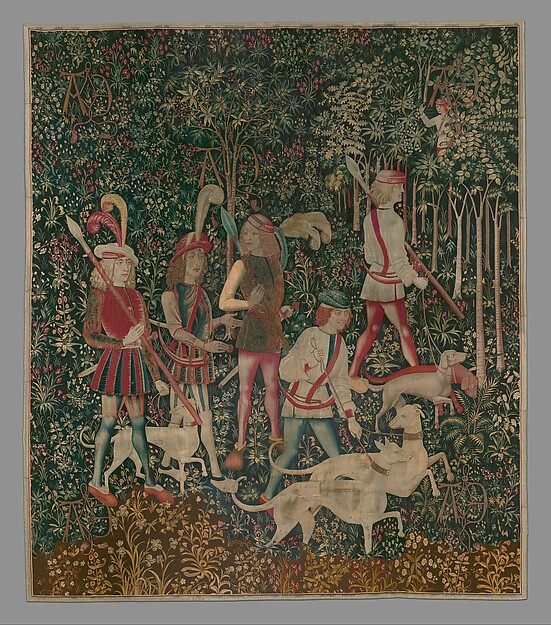
1. The hunters enter the woods
The story begins before the unicorn appears. Hounds, horns, clothing, and the direction of people’s attention establish a hunt already in progress.
2. The unicorn at the fountain
Animals gather near water while the unicorn lowers its horn. The hunters are present but not yet in control of the scene.
Read The Unicorn at the Fountain →
3. The chase at the stream
The pace changes. The unicorn crosses water as hounds and hunters press closer, using the landscape to create a difficult route through the image.
Read The Unicorn Crosses a Stream →
4. The unicorn fights back
The animal is shown as dangerous and physically powerful. This is the best panel for studying the relationship between elite hunting, dogs, weapons, and resistance.
Read The Unicorn Defends Itself →
5. The maiden fragments
Only part of this episode survives. A maiden appears near the unicorn, changing the story from forceful pursuit to a legendary form of approach.
Read The Unicorn Surrenders to a Maiden →
6. The return to the castle
The hunters carry the unicorn toward a castle. Procession, costume, architecture, and display become more important than speed.
Read The Hunters Return to the Castle →
7. The unicorn in the garden
The best-known image shows the animal alive beneath a pomegranate tree, inside a low circular fence. The collar and chain raise questions that the scene refuses to answer completely.
Read The Unicorn in Captivity →
Open The Lady and the Unicorn
The six Lady tapestries are not a sequence of hunt scenes. Each centres on a lady, lion, and unicorn against a red millefleurs field. Five are usually identified through a sensory action; the sixth remains open to several readings.
Taste
A small act of eating and a monkey with its own morsel make this panel useful for studying food, gesture, and courtly display.
Hearing
A portable organ and bellows turn a woven image into a study of music, cooperation, and attention.
Sight
The mirror and the unicorn’s pose make this panel useful for thinking about reflection, looking, and the relationship between viewer and subject.
Smell
Flowers and the monkey’s action identify the sense, while the dense ground encourages close study of plants and animals.
Touch
The lady’s contact with the horn gives this scene its focus. It is a useful panel for studying the unicorn legend, banners, posture, and control.
À mon seul désir
The motto, tent, necklace, casket, and small dog set this final scene apart from the five sensory panels. It is the best starting point for questions about choice, desire, and interpretation.
Choose a route
- Want a complete Hunt overview? Read The Hunt of the Unicorn Tapestries: Story and Meaning.
- Want the Lady cycle explained as a group? Read The Lady and the Unicorn Tapestries: Senses and Meaning.
- Want to compare the two cycles directly? Read Lady and the Unicorn vs. Hunt of the Unicorn.