The Metropolitan Museum of Art, Open Access · CC0 / The Met Open Access
Unicorn Tapestry Guide: Objects, Meaning, and How to Look
Start here to distinguish the Hunt and Lady unicorn tapestry cycles, read museum records, look closely, and understand historic woven objects versus modern prints.
Reviewed and updated
- Two separate cycles
- The Hunt of the Unicorn and The Lady and the Unicorn
- Period
- Around 1500
- Historic medium
- Images woven from coloured weft threads
- Museum collections
- The Met in New York and the Musée de Cluny in Paris
_Le_Vue_(La_Dame_%C3%A0_la_licorne)_-_Mus%C3%A9e_de_Cluny_Paris.jpg)
“Unicorn tapestry” sounds like one subject, but it can point to different objects, stories, and even methods of manufacture. A first-time reader may mean the dramatic Hunt of the Unicorn, the six works called The Lady and the Unicorn, another historic textile containing a unicorn, or a contemporary printed wall hanging based on an old image.
This guide is a map rather than another scene-by-scene retelling. It will help you identify what you are looking at, find the relevant museum record, separate observation from interpretation, and choose the next specialist guide.
Start here: choose your route
I want the hunting story
Begin with The Hunt of the Unicorn. Its surviving hangings and fragments include hunters, hounds, weapons, a fountain, moments of attack, and the famous unicorn resting beneath a pomegranate tree.
The modern sequence is compelling, but it is not a perfectly preserved picture book. Titles, surviving fragments, and the relationship of the garden hanging to the other works require care. Use the scene-by-scene index to move to individual object guides.
I want the lady, lion, unicorn, and senses
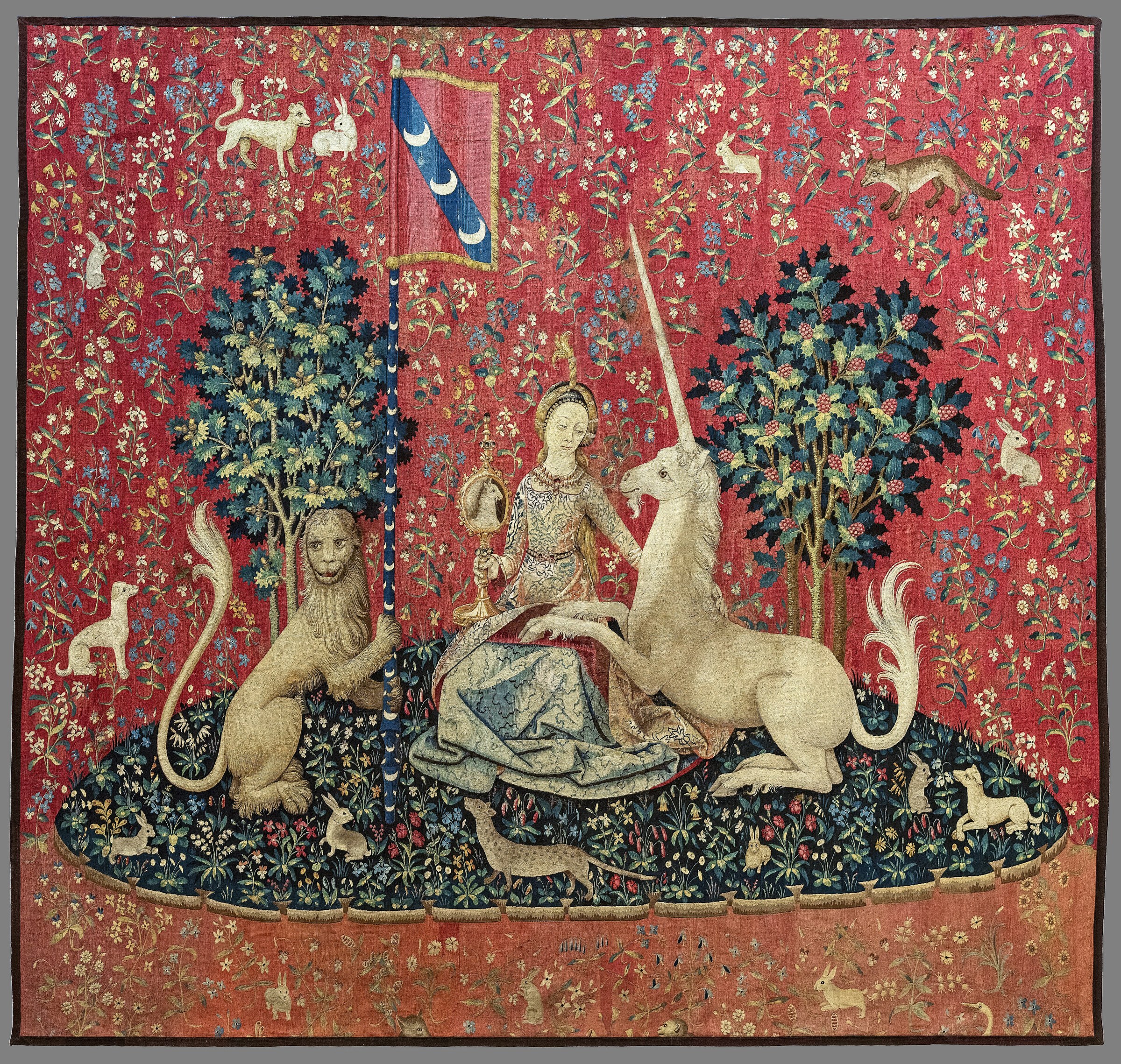
Begin with The Lady and the Unicorn. The Musée de Cluny holds six tapestries in which a lady appears with a lion and unicorn against red, animal-filled grounds. Five are conventionally associated with sight, hearing, smell, taste, and touch. The inscription À mon seul désir makes the sixth especially debated.
These works reward attention to hands, gazes, banners, musical instruments, flowers, jewellery, and the changing behaviour of small animals.
I want to compare them
Use The Lady and the Unicorn versus the Hunt. It places stillness beside action and objects beside plot without suggesting that the two cycles share a maker, patron, or original purpose.
I am looking at a modern wall hanging
Go to How to Choose a Modern Unicorn Wall Hanging. A printed textile can reproduce a historic composition, but it is not the historic woven object. The useful questions concern source image, rights, crop, dimensions, material documentation, finishing, and how the design reads at its new scale.
What can “tapestry” mean?
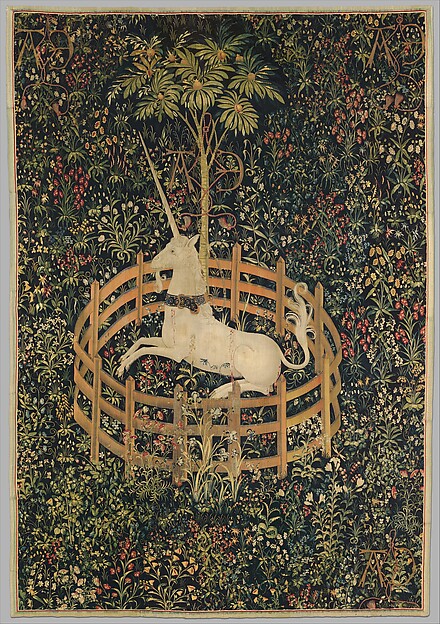
In art history, a tapestry is a woven textile in which coloured weft threads create the image as weaving proceeds. Warp threads provide the structure. Wool and silk are common in the famous unicorn works; The Met’s record for The Unicorn Rests in a Garden, for example, specifies a wool warp with wool, silk, silver, and gilt wefts.
A contemporary seller may use “tapestry” more broadly for decorative wall textiles, including printed fabric. That retail usage does not tell you how an item was made. If construction matters, begin with documentation: product specifications, reverse and edge photographs, manufacturer information, and clear material descriptions. A single front photograph is not an authentication test.
Use these terms precisely:
- Historic woven object: the physical tapestry held by a museum or collection.
- Museum photograph or digital file: a two-dimensional record of that object.
- Printed decorative wall hanging: a modern textile carrying an image applied through a documented printing process.
- Reproduction: a new version of an existing image; the term does not by itself identify material or process.
The journey from object to photograph to wall changes scale, colour, crop, texture, and context. Good guidance names which layer it is discussing.
Learn how historic tapestry weaving works →
The two-minute looking method
You do not need to decode a secret symbol to begin. Spend two minutes moving through four stages.
1. Identify the object
Find the holding institution, current title, object or accession number, date wording, dimensions, materials, and image credit. A museum record anchors the discussion to a particular object rather than a generic search image.
Titles may change. The Met currently calls object 467642 The Unicorn Rests in a Garden (from the Unicorn Tapestries), while The Unicorn in Captivity remains a familiar alternative. A title can guide interpretation, so knowing who supplied it matters.
2. Describe five visible things
Use ordinary nouns and verbs before symbolic ones. You might record:
- a lady holding a mirror while a unicorn looks towards it;
- hunters and dogs converging near water;
- a chain rising from a collar towards a tree;
- a lion holding a patterned banner;
- small animals interrupting a field of flowers.
Description is already valuable. It lets another reader check what you saw.
3. Propose one inference
Now ask what the arrangement might do. A mirror may organise a reciprocal gaze. A fence may make a garden read as enclosed. Repeated red details may connect distant parts of a composition.
Use language such as may, might, permits, or creates for the viewer. Avoid “the artist did this because…” unless a reliable source establishes that intention.
4. Name one uncertainty
What would you need to know before making a stronger claim? Perhaps the original sequence is uncertain, the crop hides a border, a title is modern, the fastening is hard to resolve, or a symbolic association comes from a general reference rather than this object’s historical context.
A useful note has two lines:
The image shows: a unicorn wearing a collar, with a chain rising towards a tree inside a fenced garden.
This might suggest: attachment without active struggle, although the intended meaning and force of the restraint remain uncertain.
See the method applied in detail in The Unicorn Rests in a Garden: Look Before You Interpret.
Why museum records matter
An object record answers questions that appearance alone cannot:
- What title does the institution currently use?
- Is the date exact, approximate, or a range?
- How does the museum phrase culture, place of design, or place of weaving?
- What materials are documented?
- What are the object’s dimensions?
- How did it enter the collection?
- Is the supplied image public domain or licensed under particular conditions?
Records also have limits. They may be updated, use cautious attribution language, or omit a contested interpretation. A record is a starting point, not proof that every label or scholarly question is permanently settled.
For travel, distinguish collection from current display. The Hunt belongs to The Metropolitan Museum of Art and is associated with The Met Cloisters. The Lady and the Unicorn belongs to the Musée de Cluny in Paris. Light-sensitive textiles may not always be displayed in the way a visitor expects, so check current museum information shortly before travelling.
How to use this publication
Unicorn Tapestries is an independent guide, not the holding museum and not a substitute for a collection record, conservator, textile specialist, or current product specification. Its useful role is to connect questions: to place two records side by side, show where a visual claim comes from, and give readers a method they can repeat.
Each article should therefore make its boundaries visible. Museum facts belong in the source list. Interpretations should be attributed or qualified. Image credits should identify the file’s origin and rights record. Practical advice about a contemporary wall hanging should state whether it comes from documented product information or general visual guidance.
If a museum updates a title, attribution, date, display status, or image record, the article may need updating too. The editorial policy explains review and correction practices, while Image Rights and Credits records the visual sources currently deployed on the site.
A visual orientation: what to notice
Borders and edges
A complete border can show where the historic composition ends. Cropping it away may make a reproduction feel more immersive, but it also removes evidence about the object’s structure and condition. Ask whether a digital image shows the whole hanging, a fragment, or a selected detail.
Gardens and millefleurs fields
Millefleurs—literally “a thousand flowers”—describes fields scattered with many small plants. Do not assume every bloom is an individually decoded message. First notice spacing, repetition, colour, and how plants separate or connect figures.
Animals and attention
The unicorn is not the only active presence. Hounds, rabbits, birds, monkeys, lions, and other animals can redirect the eye or echo a central action. Ask who notices whom before assigning a symbolic identity.
Objects and gestures
Mirrors, organs, caskets, jewellery, weapons, leashes, fountains, fences, and banners give figures something to do. Follow hands, lines, and gazes. An object’s role in the composition should be described before its possible historical associations.
Scale and surface
A phone screen makes monumental textiles look illustration-sized. Dimensions restore some perspective, but a digital file still cannot reproduce weave, reflectivity, relief, fading, repairs, or the experience of changing viewing distance. Treat photographs as documentary views with limits—not as the physical object itself.
Claim, evidence, and uncertainty
Use this compact test whenever an article, product page, or social post offers a confident explanation:
| Question | Stronger practice | Warning sign |
|---|---|---|
| Which work is this? | Gives title, institution, record, and image credit. | Says only “the medieval unicorn tapestry.” |
| What is visible? | Describes the relevant detail and its location. | Jumps immediately to a symbolic label. |
| What supports the meaning? | Names an institutional or scholarly source and attributes the reading. | Uses an unsourced universal symbol list. |
| What remains uncertain? | Identifies disagreement, missing history, crop limits, or record limits. | Presents one interpretation as a solved code. |
| Is this historic or modern? | Names woven object, museum image, or printed reproduction accurately. | Treats all three as interchangeable. |
This approach is not anti-interpretation. It makes interpretation easier to examine, compare, and enjoy.
Choose the next specialist guide
- Follow every Hunt scene: The Hunt of the Unicorn overview
- Meet all six Lady panels: The Lady and the Unicorn overview
- Compare action and stillness: Lady and the Unicorn vs. Hunt of the Unicorn
- Investigate makers and patrons: Who Made and Commissioned the Unicorn Tapestries?
- Learn weaving vocabulary: How Medieval Tapestries Were Made
- Prepare for New York: Visiting The Met Cloisters
- Research for school: Student Research Guide
- Question symbol claims: Hidden Symbols in the Unicorn Tapestries
- Choose a printed wall hanging: Modern Unicorn Wall Hanging Guide
The best first question is not “What does every unicorn mean?” It is “Which object am I looking at, what can I see, and what evidence would help me go further?”
Questions curious readers ask
What does ‘unicorn tapestry’ refer to?
It can describe any tapestry with a unicorn, but it often refers to two separate late-medieval groups: The Hunt of the Unicorn and The Lady and the Unicorn. Always identify the individual object or cycle.
Are the Hunt and Lady tapestries the same set?
No. The Hunt belongs to The Metropolitan Museum of Art in New York. The six Lady and the Unicorn tapestries are held by the Musée de Cluny in Paris.
Is every unicorn wall hanging a woven tapestry?
No. Historic tapestries were woven images. Many contemporary decorative wall hangings are printed textiles. Product documentation is more reliable than appearance alone when identifying a modern item.
Do the famous tapestries have one fixed meaning?
No single interpretation explains every object and detail. Careful reading begins with the museum record and visible evidence, then labels interpretation and uncertainty.
Where should a first-time reader begin?
Choose the Hunt for narrative and movement, The Lady and the Unicorn for the senses and courtly objects, or begin with the two-minute looking method in this guide.