Wikimedia Commons · Public Domain
_Le_Vue_(La_Dame_%C3%A0_la_licorne)_-_Mus%C3%A9e_de_Cluny_Paris.jpg)
Sight in The Lady and the Unicorn Tapestries
Explore the Sight tapestry, where the unicorn looks into a mirror held by the lady and vision becomes an intimate, carefully staged encounter.
Reviewed and updated
- Traditional sense
- Sight
- Date
- Around 1500
- Key detail
- The unicorn's reflection in a mirror
- Collection
- Musée de Cluny, Paris
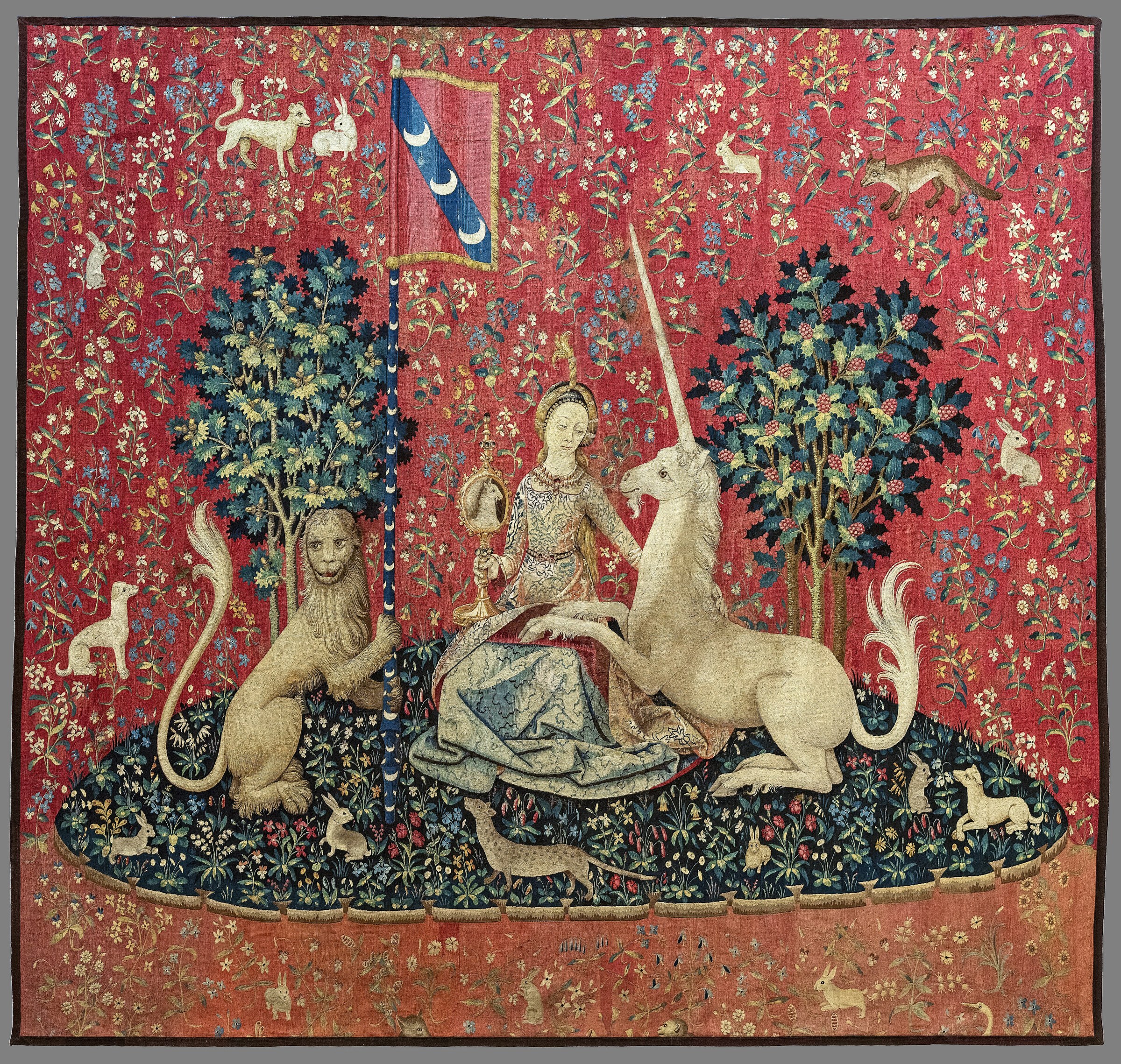
The panel traditionally called Sight presents one of the most intimate encounters in the Lady and the Unicorn series. The lady holds a mirror before the unicorn, whose forelegs rest against her lap. The animal looks toward its reflection while the lion stands to one side with the familiar heraldic banner.
The mirror gives the scene its conventional identification, but the image is richer than a simple illustration of vision. Looking here is shared, guided, and self-aware. The lady makes the reflection possible; the unicorn sees itself through an object she holds; and the viewer watches both acts at once.
A mirror at the center
The lady’s mirror is small, but it controls the entire composition. Its reflective surface directs attention to the unicorn’s head and to the relationship between the two main figures. The lady is not merely holding an attribute. She stages the moment of seeing.
Mirrors had practical uses in late medieval life, but they also carried associations with truth, self-knowledge, vanity, and representation. Those possibilities make the object especially effective in a tapestry already concerned with appearance: rich costume, heraldic banners, animals, flowers, and carefully arranged poses all invite visual attention.
The unicorn’s reflection adds another layer. A mythical creature famous for its singular horn is shown contemplating an image of itself. The scene can feel tender, playful, formal, or self-conscious depending on how the viewer reads the figures’ expressions and posture.
The unicorn’s unusual pose
Unlike the more distant heraldic animal in many medieval images, the unicorn here approaches the lady closely. Its forelegs rest against her, creating a vertical connection between the blue island at the bottom and the mirror held above.
That contact does not make the scene equivalent to the Touch tapestry. In Sight, physical closeness serves the act of looking. The unicorn is positioned so that the lady can present the mirror, and the pair becomes a single pathway for the eye.
This is an example of how the Lady and the Unicorn series keeps the senses distinct while allowing them to overlap. Sight requires an object, a gaze, and a relationship. Touch and posture support the visual exchange without replacing it.
How the composition directs the eye
Begin with the mirror, then look down to the unicorn’s head and body. From there, follow the curve of the lady’s arms and gown back to her face. The composition repeatedly returns you to the small reflective disk.
The lion’s banner provides a vertical counterweight. It links the scene with the Le Viste heraldry that appears throughout the set and prevents the closeness of the lady and unicorn from becoming isolated from the broader courtly program.
The red millefleurs field works differently from a natural landscape. Individual flowers and animals remain visible against the flat ground, so the central blue island reads almost like a stage. Sight becomes an event displayed before a patterned audience of plants and creatures.
Reflection and self-knowledge
Modern viewers often connect mirrors with self-knowledge, and that association can be useful here. The unicorn is not simply being admired by the lady; it is shown in a situation where it can see itself. The image may invite questions about identity, appearance, and the relation between a living body and its representation.
At the same time, the tapestry belongs to a courtly visual culture in which fine surfaces were themselves meaningful. Silk, wool, and metal-wrapped threads could create differences of texture and light. A mirror inside an object designed to shimmer and change with viewing conditions is especially apt.
It is not necessary to decide whether the image is morally warning against vanity or celebrating beautiful appearance. The tension between those possibilities is one reason the panel stays compelling.
Details worth close attention
Compare the lady’s calm face with the unicorn’s alert head. Notice how the animal’s horn interacts with the space around the mirror. Then move outward to the lion, the banners, and the small creatures in the flowered field.
The panel also rewards attention to fabrics. Tapestry can imitate embroidery, fur, velvet, hair, and reflective ornament through changes in weave and color. Because the sense is sight, the makers seem especially interested in giving the viewer surfaces to inspect.
Sight within the series
The traditional sense labels help organize the six tapestries, but Sight shows why they should not be treated as a rigid checklist. The panel involves looking, touching, reflection, self-presentation, and the possibility of desire. It is a sensory image with social and emotional complexity.
Compare it with Touch, where the lady directly holds the unicorn’s horn, or return to The Lady and the Unicorn overview for the full group.