Wikimedia Commons · Public Domain
_Le_toucher_(La_Dame_%C3%A0_la_licorne)_-_Mus%C3%A9e_de_Cluny_Paris.jpg)
Touch in The Lady and the Unicorn Tapestries
Examine the Touch tapestry, where the lady holds the unicorn's horn and a formal courtly arrangement becomes an image of contact and control.
Reviewed and updated
- Traditional sense
- Touch
- Date
- Around 1500
- Key detail
- The lady's hand on the unicorn's horn
- Collection
- Musée de Cluny, Paris
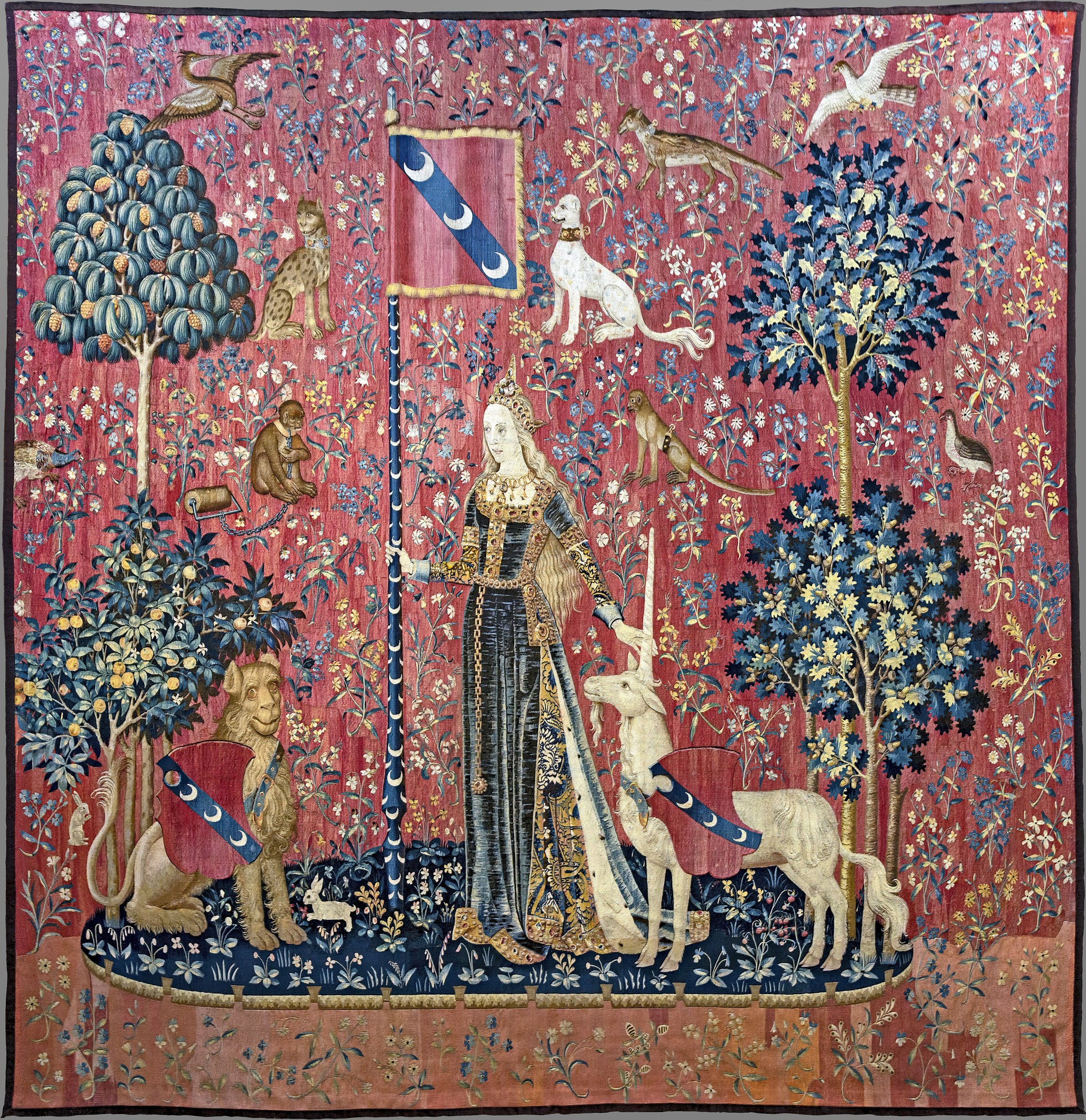
In the tapestry known as Touch, the lady stands between the lion and the unicorn, one hand holding a banner and the other resting directly on the unicorn’s horn. The action is remarkably simple. Yet it transforms the formal arrangement of heraldic animals and rich costume into a scene about contact, confidence, and the power to approach something wild.
The hand on the horn provides the usual identification of the sense. It also connects this panel with long traditions about the unicorn’s rarity and elusive nature. In many medieval stories, the creature cannot be approached easily. Here, it stands calmly beside the lady.
What makes this the Touch panel?
Among the six tapestries, Touch offers the most direct sensory clue. There is no instrument to hear, mirror to look into, or food to eat. The lady’s hand meets the unicorn’s horn. The gesture is clear enough to organize the entire image.
The contact is controlled rather than dramatic. The unicorn does not recoil or resist. The lady does not grasp the horn as if wrestling with the animal. Her posture makes touch appear deliberate, composed, and socially meaningful.
That restraint is typical of the series. Bodily senses are not shown through uncontrolled action. They are shaped by etiquette, dress, objects, and courtly ceremony.
The horn and the unicorn legend
The unicorn’s horn was one of the creature’s defining features in medieval literature and art. It could signify strength, uniqueness, purity, or marvelous power. Objects believed to be unicorn horns—often actually narwhal tusks—were collected and valued in European courts.
Touching the horn therefore means more than touching an animal. The lady reaches the very feature that identifies the unicorn as exceptional. The gesture can suggest familiarity, authority, gentleness, or a relationship built on trust.
Christian allegories of the unicorn’s capture by a virgin offer one possible context, but Touch should not be collapsed into a single religious narrative. The Lady and the Unicorn set has its own courtly focus and does not repeat the violent hunt scenes of the separate Unicorn Tapestries at The Met Cloisters.
Contact, control, and mutual presence
The image invites a question: who controls the encounter? The lady’s hand is active, but the unicorn is large, upright, and visibly present. Neither figure disappears into the other’s role.
This balance makes the panel more interesting than an image of simple domination. The lady can touch the horn because the unicorn permits proximity. The animal’s apparent calm gives the contact its force.
The lion at the opposite side maintains the set’s formal symmetry. Both beasts support banners connected with the Le Viste arms, turning the encounter between woman and unicorn into part of a broader statement about lineage, wealth, and courtly identity.
The body within a tapestry surface
Touch is also a useful panel for thinking about tapestry as a material object. The scene represents contact, but it is itself made through countless interlaced threads. Wool, silk, and other costly materials create the effect of skin, hair, fabric, flowers, and animal fur without actually being any of those things.
A viewer standing near the hanging can see the woven surface that produces the illusion. From farther away, the eye reads a lady’s hand touching a horn. The artwork therefore moves between tactile reality and visual representation.
This double quality may explain why the panel feels so compelling. It is not only about touch as a subject; it invites attention to the texture of the thing being viewed.
How to look closely
Start at the lady’s hand on the horn, then trace the line of the horn up and away from her body. Notice the unicorn’s face and stance. Next compare the lady’s other hand, which holds the banner: one hand connects with an animal, the other with heraldic identity.
Then step back. The central blue island creates a stable platform for the three main figures, while the red field surrounds them with flowers and small animals. This calm geometry keeps physical contact from becoming chaotic.
Finally, notice costume details. The lady’s gown, the animal bodies, and the banners all demonstrate the tapestry makers’ ability to differentiate texture through colored threads. In a panel about touch, those visible imitations of tactile materials are especially worth attention.
Touch within the six scenes
The traditional five senses are not just abstract labels pasted onto similar compositions. Each panel finds a different way to make a bodily experience visible. In Touch, the key action is contact across the boundary between human and animal.
Compare it with Sight, where the lady mediates the unicorn’s reflection, or return to The Lady and the Unicorn overview to consider all six tapestries together.