Wikimedia Commons · Public Domain
_Le_Go%C3%BBt_(La_Dame_%C3%A0_la_licorne)_-_Mus%C3%A9e_de_Cluny_Paris.jpg)
Taste in The Lady and the Unicorn Tapestries
Explore the Taste tapestry, where a lady takes a sweet, a monkey eats its own morsel, and a courtly scene turns eating into an allegory.
Reviewed and updated
- Traditional sense
- Taste
- Date
- Around 1500
- Key detail
- A sweet offered from a dish and a monkey eating
- Collection
- Musée de Cluny, Paris
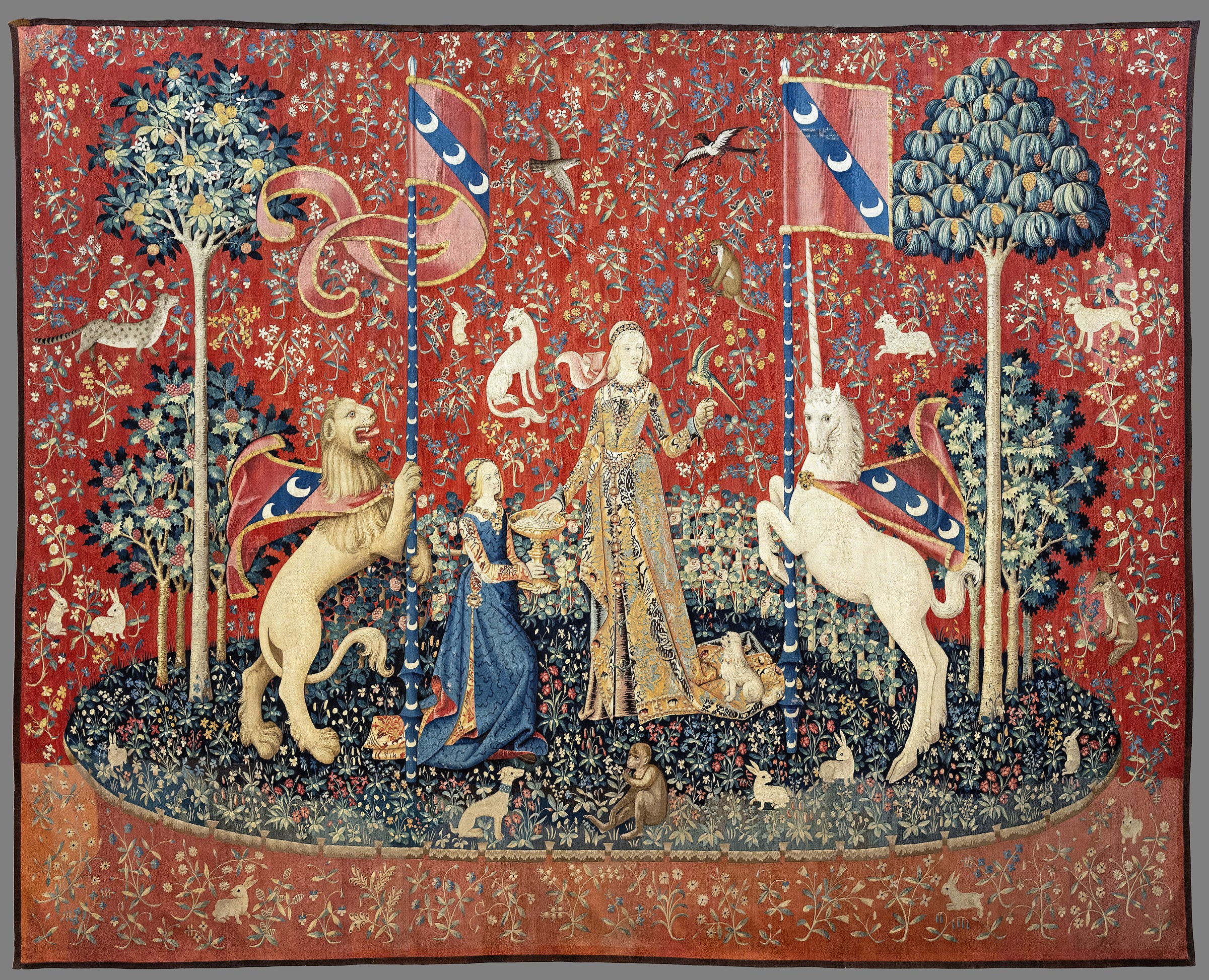
In the tapestry traditionally called Taste, the lady stands between the familiar lion and unicorn while taking a sweet from a dish held by her attendant. Near her feet, a monkey eats a small morsel of its own. The actions are modest, but they turn a crowded field of flowers, animals, costume, and heraldry into a scene about appetite and choice.
Taste is often introduced as the simplest of the five sense panels because eating is visible. Looking closely makes it more complicated. The lady’s deliberate gesture differs from the monkey’s immediate consumption, and the lavish setting turns an everyday bodily sense into a courtly performance.
What is happening in the panel?
The lady reaches toward a confection or sweetmeat offered by an attendant. Her action is controlled and formal rather than hungry or hurried. The monkey provides a smaller, more animated echo of the same sense by eating nearby.
The lion and unicorn hold banners displaying the Le Viste arms associated with the commission. They frame the central action, but they do not simply function as symmetrical ornaments. The animal pair helps make each tapestry feel ceremonial and links the scenes into a group.
All of this unfolds on the series’ characteristic red millefleurs ground. The field is scattered with flowers, small animals, and trees rather than organized as a realistic landscape. It is an imagined courtly space: rich, enclosed by pattern, and made for slow looking.
Why the monkey matters
In medieval and Renaissance visual culture, monkeys could be associated with imitation, appetite, foolishness, or human behavior viewed at a comic distance. That does not mean the monkey in Taste has one unchanging meaning. It does make the pairing with the lady significant.
Both figures are connected with eating, but they do not behave alike. The lady’s gesture is socially choreographed; the monkey’s is more direct. The contrast can invite viewers to think about refinement, bodily appetite, and the difference between instinct and cultivated conduct.
The monkey is also a practical compositional device. Its small body draws attention downward and creates a second scale of action beneath the tall central figures. The series repeatedly uses animals this way: they carry possible associations while making the ornamental field feel alive.
Taste as a courtly sense
The five-senses program is not a modern scientific diagram. It presents sensation through the objects, gestures, and pleasures of an elite world. In Taste, food is precious, served, and selected. The scene concerns not only what enters the mouth but how desire is managed in public.
This helps explain why the tapestry can feel restrained rather than indulgent. The lady does not dominate the scene through excess. Her posture, clothing, and attendants turn the sensory act into a display of poise.
A Christian or moralizing viewer might have considered the risks of appetite, while a courtly viewer could admire abundance, hospitality, and self-command. The tapestry does not force a single lesson. It makes the tension between pleasure and restraint visible.
Details to examine
Start with the dish. Its scale and position identify the main action without overwhelming the composition. Then compare the lady’s hand with the monkey’s paws. Notice the relationship between the two animals flanking her: their banners connect the immediate scene to the family and social world behind the commission.
The lady’s clothing deserves attention as well. Tapestry weavers used changes of colored wool and silk to suggest rich textiles, folds, and ornament. A work like this was itself a luxury object representing luxurious objects. Its material brilliance was part of the meaning.
Finally, scan the red field for flowers and small animals. Avoid treating each one as a code to solve. Their combined effect is abundance—a visual counterpart to the delicacy being offered.
Taste within the six-tapestry set
Taste is one of five panels conventionally linked to the senses. The identification depends on clear clues: food for taste, music for hearing, a mirror for sight, a flower for smell, and contact with the unicorn’s horn for touch. The sixth tapestry, À mon seul désir, complicates the whole sequence by introducing desire without a simple sensory label.
Seeing Taste alongside the others makes its quiet precision more apparent. The senses are not merely named; they are staged as relationships among body, object, animal, and social ritual.
Continue with Smell or return to The Lady and the Unicorn overview.