Wikimedia Commons · Public Domain
_L%27Odorat_(La_Dame_%C3%A0_la_licorne)_-_Mus%C3%A9e_de_Cluny_Paris.jpg)
Smell in The Lady and the Unicorn Tapestries
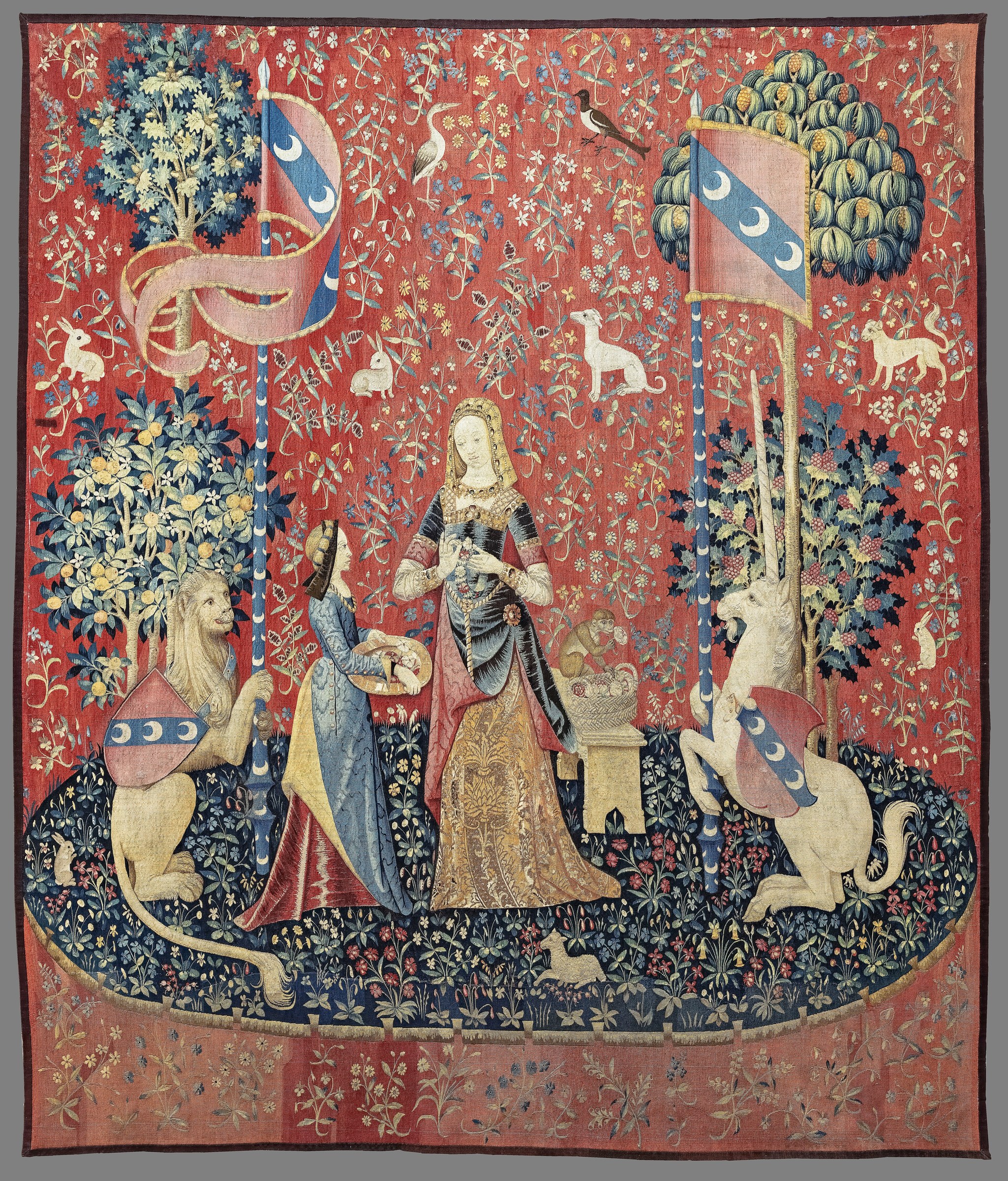
A close reading of the Smell tapestry, where a lady makes a wreath, a monkey sniffs a flower, and the millefleurs field becomes part of the sense.
Reviewed and updated
- Traditional sense
- Smell
- Date
- Around 1500
- Key detail
- A wreath of flowers and a monkey smelling a bloom
- Collection
- Musée de Cluny, Paris
The panel called Smell turns a single flower into an entire atmosphere. The lady makes a wreath while her attendant holds a basket of blossoms. A monkey nearby raises a flower to its nose. Around them, the red field is scattered with plants, trees, birds, and animals in the millefleurs style that makes the Lady and the Unicorn tapestries feel both patterned and alive.
The monkey provides the clearest clue to the traditional sense. But the tapestry’s meaning does not rest on that small gesture alone. Smell is conveyed through gathering, arranging, holding, and imagining flowers in an environment that cannot literally give off a scent.
A flower wreath at the center
The lady’s hands are occupied with flowers. Rather than simply displaying a bouquet, she appears to make or arrange a wreath. That action brings together manual skill, courtly leisure, and sensory pleasure. The attendant’s basket supplies the material; the lady’s gesture transforms it into an ornament.
A wreath can carry several associations. Flowers may suggest spring, love, celebration, devotion, or transience, depending on context. In this panel, their immediate role is more concrete: they make smell visible through an activity involving selection and close attention.
The lion and unicorn remain at either side with the Le Viste banners. Their formal presence makes a small domestic activity look ceremonial. The result is typical of the cycle: a private sensory experience unfolds as a public, carefully arranged image.
The monkey and the sense of smell
The monkey’s flower is a visual shorthand for scent. It also creates a contrast with the lady. She composes a wreath; the monkey responds directly to one bloom. The difference can suggest cultivated behavior alongside instinctive pleasure, but it need not be reduced to a moral lesson.
Monkeys appear in other medieval images as comic imitators of people. Here, imitation may be part of the joke: the monkey performs a simpler version of the refined floral attention happening above. The animal is small, but it gives the viewer a precise sensory cue.
Look at how the monkey’s body breaks the lower edge of the central group. It prevents the tapestry from becoming stiffly symmetrical and gives the eye a route from the lady’s hands to the ground’s scattered flowers.
Millefleurs and the problem of representing scent
A tapestry cannot release fragrance, so Smell relies on visual abundance. The millefleurs ground is not a botanical survey with every plant identified and placed in natural depth. It is a decorative field in which separate blossoms remain visible across a flat red surface.
That format is ideal for the subject. Flowers surround the action without turning into a single garden view. The viewer is invited to imagine an accumulation of scents rather than a specific location with one measurable smell.
Individual plants in late medieval art can have religious, medicinal, seasonal, or courtly associations. Some may be recognizable, while others are generalized. It is best not to insist that every flower must deliver a fixed secret message. The strength of the panel lies in how many small forms produce a general sense of cultivated abundance.
Courtly refinement and the senses
The Lady and the Unicorn set treats the senses as experiences shaped by status and ritual. Smell is not represented through labor, dirt, smoke, or the ordinary odors of a city. It is represented through fresh flowers, a finely dressed lady, an attendant, heraldic animals, and a luxurious textile.
This does not make the sense unreal. It shows how courtly culture framed sensory pleasure. A flower is gathered, chosen, arranged, and displayed. The woman at the center appears to control the rhythm of the scene, while the surrounding figures and animals amplify it.
The design can also invite questions about desire. Fragrance is fleeting; a wreath lasts only briefly; flowers bloom and fade. Those facts may have been part of the pleasure rather than a warning against it.
How to look closely
First find the lady’s hands, then trace the chain of flowers from basket to wreath to monkey. Next, compare the large flowering action with the many smaller blooms distributed through the field. Finally, notice the difference between the central blue island and the surrounding red ground.
Color contributes to the sense of separation and attention. The blue island creates a stage for the main figures, while the red field pushes flowers and animals forward as individual accents. In the original hanging, silk threads would have added changing highlights to costume and details as light moved across the surface.
Smell within the series
The traditional identification of this panel is unusually secure because of the monkey smelling a flower. Yet the tapestry gains depth when seen with the other senses. Taste considers appetite; Hearing turns music into a collaborative action; and Smell makes an invisible sensation present through flowers, hands, and imagination.
Return to The Lady and the Unicorn overview to see the six works together.