Wikimedia Commons · Public Domain
_Mon_seul_d%C3%A9sir_(La_Dame_%C3%A0_la_licorne)_-_Mus%C3%A9e_de_Cluny_Paris.jpg)
À mon seul désir: The Sixth Lady and the Unicorn Tapestry
Explore À mon seul désir, the Lady and the Unicorn tapestry with a blue tent, a necklace, and an inscription that still resists one settled meaning.
Reviewed and updated
- Inscription
- À mon seul désir
- Date
- Around 1500
- Key details
- Blue tent, necklace, casket, lion, and unicorn
- Collection
- Musée de Cluny, Paris
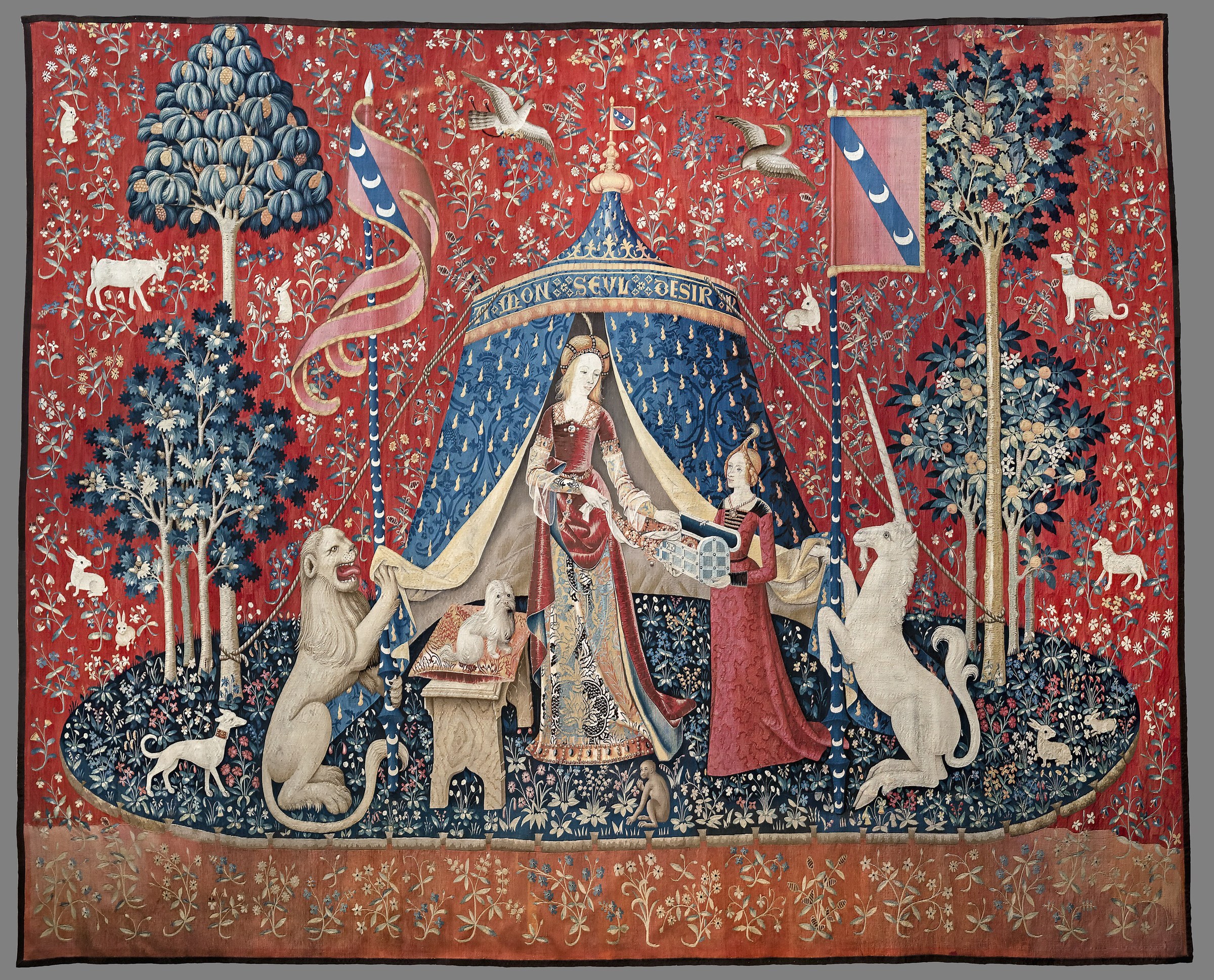
À mon seul désir is the most debated tapestry in the Lady and the Unicorn set. Unlike the five panels traditionally connected with taste, hearing, sight, smell, and touch, it does not present one obvious bodily sense. The lady stands before a blue tent, attended by a servant holding an open casket. Her hands meet a necklace, but the direction of the action remains unclear: is she taking it out, putting it away, or doing something more symbolic?
Above the tent appears the inscription À mon seul désir, commonly translated as “To my only desire.” The words and the gesture make the panel feel like a culmination, but they do not tell viewers exactly what has been chosen.
The blue tent and its motto
The blue tent dominates the upper part of the composition. Its scale creates a sheltered interior within the already artificial space of the red millefleurs field. The lion and unicorn stand at either side, framing the entrance as they frame the lady in the other tapestries.
The tent’s inscription is unusual because it introduces language into a set that otherwise relies on objects and actions. It directs the viewer to desire, but leaves the phrase open. Is desire a private wish, a beloved person, a moral choice, a courtly ideal, or a statement of self-command?
The answer may be deliberately unavailable. The panel creates a setting in which choosing matters more than an easily identifiable object.
The necklace and the casket
The attendant holds an open casket while the lady handles a necklace. Many interpretations begin with the simplest uncertainty: does she remove the necklace from the casket or place it inside?
If she is taking it out, the action may suggest adornment, acceptance, pleasure, or the embrace of worldly beauty. If she is putting it away, it may suggest renunciation, restraint, or mastery over the pleasures represented by the five senses. Both readings have long appealed to viewers because the gesture can plausibly support either one.
It is also possible that the panel concerns not rejection or acceptance but the freedom to choose. The lady’s action is deliberate, centered, and watched over by the heraldic animals. Desire may be presented as something governed by judgment rather than simply experienced.
Why the sixth panel changes the series
The five-senses interpretation gives the group a clear structure. Taste uses food, Hearing uses an organ, Sight uses a mirror, Smell uses flowers, and Touch uses the unicorn’s horn. À mon seul désir refuses that tidy pattern.
Instead, it asks what happens after sensory experience. Is desire the sum of the senses, their restraint, their refinement, or a separate capacity of the mind and will? The tapestry does not explain itself, which is why it can feel less like an extra panel and more like a challenge to the whole program.
The lady’s central role becomes especially important here. Across the series she plays, looks, touches, selects, and performs. In this scene, she appears to make a choice whose consequences are not narrated. Her agency holds the composition together.
A courtly world of objects and signs
The necklace, tent, banners, costume, animals, and flowers all belong to a language of courtly display. They show wealth and refinement while also raising questions about how material beauty should be used.
The tapestry itself participates in that language. It is a costly luxury object depicting costly textiles and jewelry. Wool, silk, and careful color changes create the appearance of surfaces that viewers might want to touch or possess. A scene about desire is woven from the very materials of visual desire.
This does not mean the tapestry condemns luxury. It lets luxury become part of the question. The image asks viewers to consider whether beautiful things are merely possessed, freely chosen, set aside, or made meaningful through the way one relates to them.
How to look without forcing an answer
Begin with the necklace and follow the line to the lady’s hands. Then look to the casket, the attendant, and the opening of the tent. Notice that each element supports the action without resolving it.
Next, compare the lion and unicorn with their positions in the other panels. They preserve the set’s visual order even as the sixth scene becomes conceptually uncertain. Finally, read the motto as part of the composition rather than as a caption that settles everything.
The best response is to hold multiple possibilities in view. The tapestry is not incomplete because it has no universally accepted meaning. Its ambiguity is carefully made: the makers provide an inscription, an object, and a gesture, then stop before turning them into a single moral statement.
The final panel—or a different kind of scene?
The position of À mon seul désir within the series encourages its reading as a finale, though the original sequence and purpose of the six tapestries cannot be reconstructed with perfect certainty. It feels climactic because it gathers motifs from the other scenes—dress, ornament, animals, touch, looking, and choice—into one enclosed setting.
Whether it represents renunciation, desire, free will, or an ideal beyond the five senses, it gives the series a lasting unresolved ending. The lady’s hands remain at the center of that mystery.
Return to The Lady and the Unicorn overview or compare the sixth scene with Taste, where choice is shown through a much smaller act.