How to Recognize Medieval Unicorn Tapestry Features
A visual checklist for recognising medieval unicorn tapestry design: composition, animals, millefleurs, heraldry, materials, and the difference between historic works and modern fantasy decor.
Reviewed and updated
- Purpose
- Recognise visual features rather than memorise one symbolic meaning
- Key signs
- Millefleurs, courtly figures, heraldry, dense woven detail, and structured composition
- Important caution
- A unicorn alone does not make an image medieval
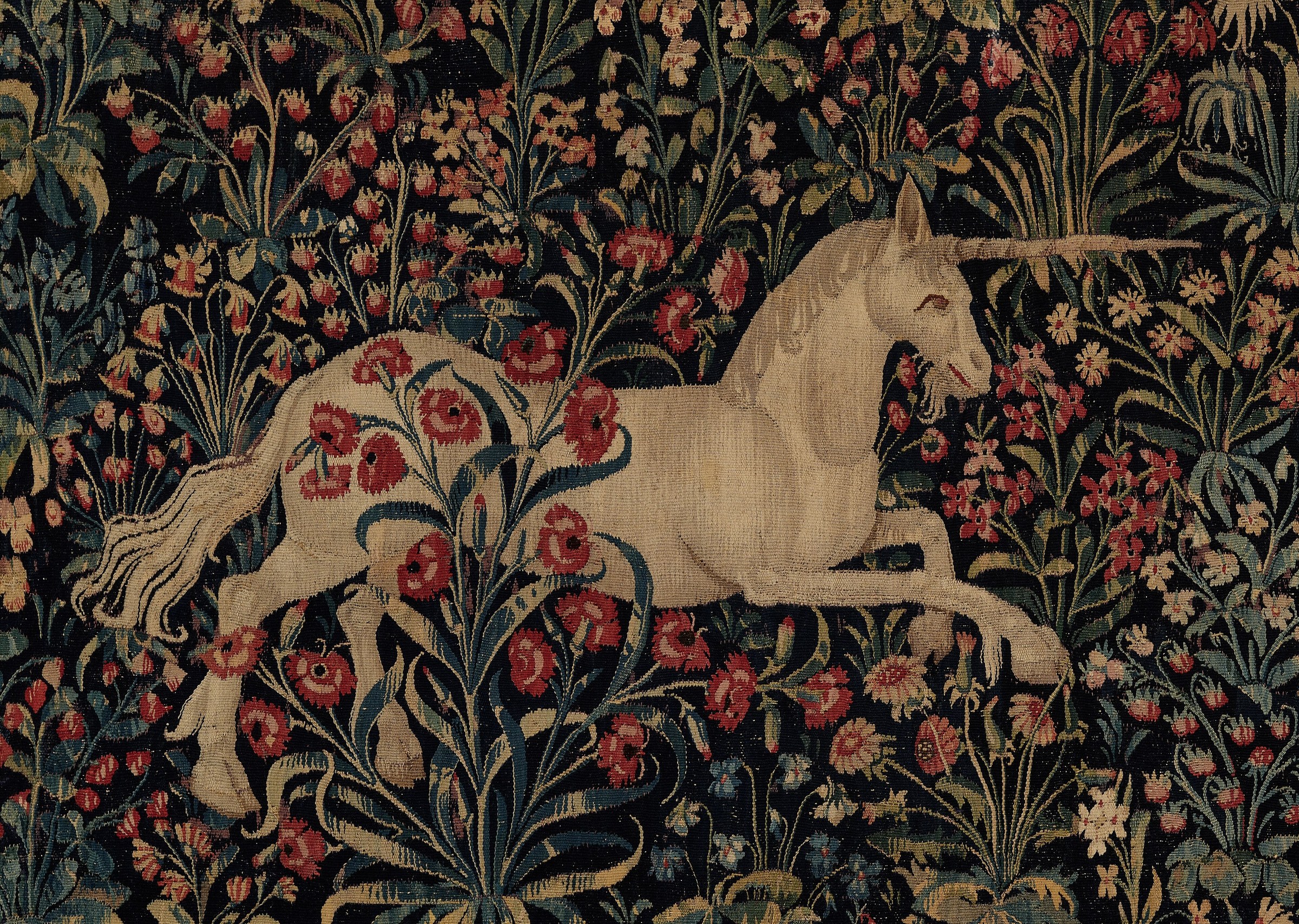

A unicorn picture is not automatically medieval because it has an ornate border, dark colours, or a horse with one horn. Historic medieval tapestry uses a particular visual language: figures, animals, plants, clothing, status, and pattern work together in a carefully ordered surface.
This article is a recognition checklist. For the history of the two most famous tapestry cycles, use the main Unicorn Tapestry guide. For advice on buying modern wall decor, use How to Choose a Modern Unicorn Wall Hanging.
Check the composition before the details
A medieval-inspired tapestry usually has a strong organising structure. It may use a central figure with animals on either side, a procession moving toward a building, or a hunt that guides the eye across a landscape. The image is dense, but it is not random.
Ask these questions:
- Where does the eye go first?
- Which figures control the scene?
- Do animals reinforce the action or merely fill empty space?
- Is the border part of the image, or just decoration added around it?
- Can the scene still be understood from a distance?
In The Lady and the Unicorn, the lady, lion, and unicorn establish a stable centre. In The Hunt of the Unicorn, dogs, hunters, water, and trees move the viewer through a sequence. Both structures are very different from a modern logo-like unicorn floating against a generic background.
Look for plants used as a surface
A common feature is millefleurs: a field filled with many small plants, flowers, and animals. It does not behave like a modern realistic landscape with one horizon, one season, and consistent perspective. Instead, the surface stays decorative and close to the viewer.
Millefleurs is not just “lots of flowers.” In a strong design, the plants make space around people and animals, repeat colours across the field, and reward close looking without obscuring the main action. A weak imitation often uses a repeated floral pattern that has no relationship to the scene.
Notice the relationship between people and animals
Medieval unicorn tapestry imagery often gives animals a social role. Hounds identify a hunt. A lion and unicorn may frame arms or a central figure. Rabbits, birds, monkeys, and other creatures make the ground feel active and enlarge the visual world around the main subject.
The animal should have a reason to be present. In a historic-style hunt, the unicorn is difficult to capture and changes the behaviour of everyone around it. In a sensory scene, an animal can echo an action, direct attention, or establish rank. When a design adds a unicorn simply as a decorative silhouette, it usually loses this relationship.
Identify signs of courtly life
Historic tapestry designs often show status through material and arrangement rather than through written explanation. Look for formal clothing, banners, arms, attendants, hunting equipment, elaborate tents, castles, musical instruments, caskets, or carefully staged gestures.
These elements do not guarantee that a work is medieval, but they help distinguish courtly imagery from generic fantasy. A unicorn beside a knight in invented armour is not the same visual tradition as a unicorn beside heraldic banners, a portable organ, or a carefully woven millefleurs field.
Separate woven structure from a printed effect
A historic tapestry is built on a loom. Its visible picture comes from weft threads crossing structural warp threads. That construction produces changes in texture, small stepped colour transitions, and a surface that behaves differently from paint or an inkjet print.
Modern reproduction can still be attractive. The useful distinction is descriptive, not judgmental:
- Historic tapestry: an original woven object made for a historical setting.
- Woven reproduction: a modern textile that uses yarns to approximate an image.
- Printed wall hanging: an image printed on fabric or another surface.
- Medieval-inspired design: a contemporary work borrowing selected visual features.
Clear language prevents a product listing from making a larger historical claim than the object supports.
Use a five-point checklist
Before calling a unicorn design “medieval,” see whether it has at least several of these features:
- A coherent narrative or ceremonial composition.
- Courtly figures, animals, gestures, and objects that relate to one another.
- A millefleurs field or a deliberately structured landscape.
- Heraldic, architectural, textile, or hunting details connected to status.
- A material choice that is honestly described as historic, woven reproduction, print, or contemporary design.
A modern artist does not need to copy every feature to make a thoughtful adaptation. The strongest designs understand why the original imagery works: it balances pattern with action, ornament with status, and fantasy with a believable social world.
For examples of how tapestry design changed in later periods, see Types of Tapestries: A Guide.