Types of Tapestries: A Visual Guide to Styles and Subjects
Learn the major types of tapestries, from medieval millefleurs and hunting scenes to Renaissance histories, verdure, armorial, and modern designs.
- Tapestry means
- A weft-faced woven picture, not simply any printed wall cloth
- Common subjects
- Stories, hunts, gardens, scripture, mythology, heraldry, and landscapes
- Easy clue
- Start with the background: flowers, foliage, architecture, or open landscape
- Remember
- Style, subject, period, and technique are different ways to classify one work
%2C_BK-17252.jpg)
Tapestries are wonderfully difficult to place in tidy boxes. One hanging can be a hunting tapestry, a millefleurs tapestry, a courtly love story, and a late medieval luxury object at the same time.
Still, learning a few broad types of tapestries makes museum galleries and old interiors much easier to read. The secret is to ask three questions:
- What is shown?
- How is the space designed?
- What was the tapestry meant to do in its room?
Here are the major families you are most likely to meet.
Narrative tapestries: stories across the wall
Narrative tapestries show events. A single hanging may capture one dramatic moment, while a series can unfold like episodes in a prestige television drama—only woven, enormous, and made for a palace.
Subjects came from scripture, classical history, romance, war, poetry, and legend. Sets about Troy, Abraham, the apostles, or heroic rulers allowed patrons to surround themselves with stories that reflected courage, faith, ancestry, or political ambition.
Look for: repeated characters, gestures that direct the eye, and scenes designed to be viewed in sequence.
The Hunt of the Unicorn is a famous narrative cycle, although its story leaves room for allegory as well as action.
Hunting tapestries: motion, landscape, and status
Hunting scenes combine animals, fashion, landscape, and movement. They were especially suited to aristocratic settings because hunting itself was tied to land, privilege, training, and courtly ritual.
Some hunts depict recognizable quarry such as deer or boar. The unicorn turns the familiar structure of a hunt into something stranger: the pursued animal belongs to legend, and capture may carry religious or romantic meaning.
Look for: hounds doing much of the narrative work. Their noses, bodies, and direction often tell you what has just happened or what is about to happen.
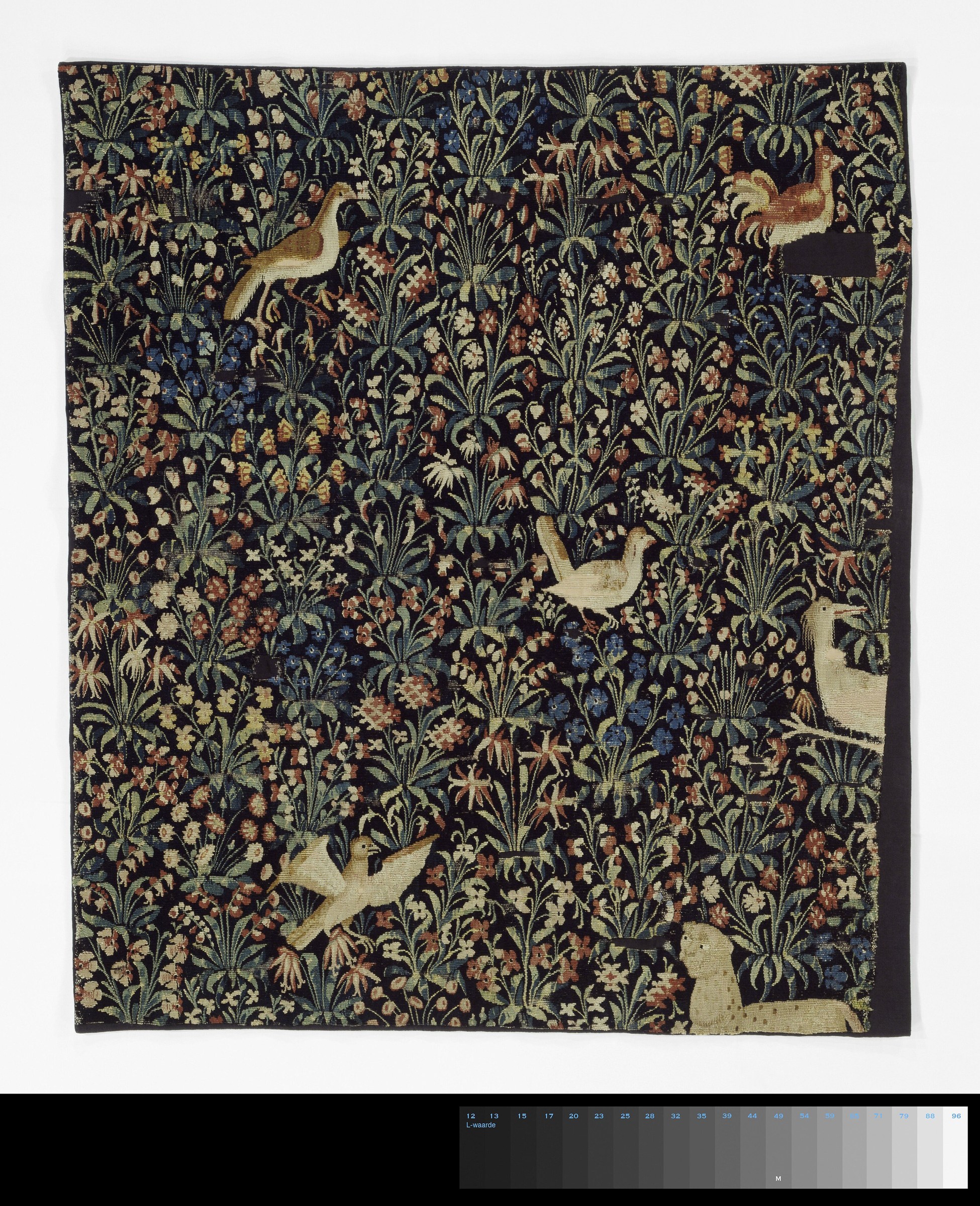
Millefleurs tapestries: a thousand flowers
In a millefleurs tapestry, figures and animals appear against a ground scattered with small plants. The flowers may be carefully observed, but they do not necessarily share a realistic landscape. A spring flower can bloom beside one from another season.
The style creates a sense of abundance and enchantment. It also rewards close viewing: a rabbit, bird, violet, strawberry plant, or tiny insect can become a discovery.
Both The Lady and the Unicorn and parts of the unicorn tradition use this flower-strewn visual language.
Look for: a ground that behaves more like a rich pattern than a window into deep space.
Verdure tapestries: rooms made green
Verdure tapestries are dominated by foliage. Trees, leafy plants, and woodland views can fill nearly the entire surface, sometimes with birds, animals, buildings, or small human scenes tucked inside.
They became especially popular because they brought an imagined outdoors into formal interiors. Verdure could be less expensive than a complex figure cycle, but the best examples create an absorbing world of layered greens and distant views.
Look for: foliage as the main event rather than a background added behind figures.
Biblical and devotional tapestries
Biblical tapestries could serve worship, ceremony, dynastic display, or moral instruction. Subjects ranged from the lives of Christ and the apostles to Old Testament rulers and patriarchs.
In royal settings, a biblical hero might also reflect the patron. A king displaying Abraham, David, or Solomon invited viewers to connect sacred history with contemporary rule.
Look for: halos and familiar attributes, but also contemporary clothing and architecture. Artists often dressed ancient stories in the visual world of their own century.
Classical and mythological tapestries
Renaissance enthusiasm for Greece and Rome created immense woven stories about gods, generals, emperors, and legendary wars. The tales of Scipio, Troy, Alexander, and the gods supplied action as well as lessons about leadership, virtue, desire, and fate.
These sets often use muscular figures, columns, arches, and deep architectural settings inspired by Renaissance painting.
Look for: ancient subject matter wearing Renaissance theatrical costume.
Explore several examples in our Renaissance tapestry guide.
Armorial tapestries: identity at room size
An armorial tapestry prominently displays coats of arms, badges, initials, or emblems. It might commemorate a marriage, announce ownership, decorate a ceremonial room, or travel with a household.
Heraldry can also help historians identify patrons. In The Lady and the Unicorn, repeated arms associated with the Le Viste family are one of the most important clues to the set’s original context.
Look for: shields, repeated colors, family devices, and animals behaving like formal supporters rather than participants in a natural scene.
Grotesque tapestries: elegant fantasy with an ancient accent
Renaissance grotesque design grew from the rediscovery of ancient Roman decoration. Delicate frameworks might combine scrolls, masks, vases, fantastical creatures, foliage, and tiny figures in arrangements that ignore normal gravity.
The word did not originally mean ugly. It referred to strange ornamental designs associated with rooms discovered underground like caves, or grotte.
Look for: symmetrical fantasy architecture too light and playful to exist in the real world.
Pastoral tapestries: an imagined country life
Pastoral tapestries show shepherds, lovers, ruins, gardens, music, and leisurely landscapes. They became particularly fashionable in later centuries, offering courtly viewers an idealized countryside without much mud or hard agricultural labor.
Look for: elegant people pretending to be rustic in a landscape designed for pleasure.
Modern and contemporary tapestries
Tapestry did not end with palaces. Modern artists and weavers explored abstraction, bold color, politics, texture, and monumental public art. Some artists supplied designs to workshops; others treated weaving itself as the creative act.
A contemporary tapestry can be just as technically serious as a historic one while looking nothing like a medieval hunt.
Look for: how the artist uses the physical character of thread—softness, weight, irregularity, and scale—rather than imitating a painting.
What about printed “tapestries” sold today?
Online shops often use tapestry for any decorative fabric wall hanging. A printed polyester cloth and a woven jacquard reproduction can show the same unicorn, but they are not made in the same way.
Useful product terms include:
- printed wall hanging: the image sits on the fabric surface;
- jacquard-woven reproduction: colored threads create the design through patterned weaving;
- handwoven tapestry: produced by a weaver, usually in limited quantities;
- needlepoint or embroidery: stitches decorate an existing ground fabric.
None of these labels automatically guarantees beauty or quality. They simply tell you what kind of object you are considering.
A simple way to identify a tapestry style
When you encounter an unfamiliar tapestry, try this quick route:
- Start with the background: flowers, leaves, architecture, or open landscape?
- Find the action: story, ceremony, hunt, music, or no action at all?
- Look for identity clues: arms, initials, crowns, or recognizable saints?
- Notice the space: flat and patterned, or deep and theatrical?
- Finally, look at the threads. Is the image woven, embroidered, or printed?
You do not need to name everything immediately. Good looking begins with noticing—and tapestry always gives you more to notice.
Questions curious readers ask
What are the main types of tapestry?
Common types include narrative, hunting, millefleurs, verdure, biblical, mythological, armorial, grotesque, pastoral, and modern artist-designed tapestries. A single tapestry may fit several groups.
What is a millefleurs tapestry?
Millefleurs means ‘a thousand flowers.’ These tapestries place figures or animals against a field scattered with many small flowering plants, usually without a continuous horizon.
What is a verdure tapestry?
A verdure tapestry is dominated by green foliage, trees, and landscape. Animals, buildings, or small narrative scenes may appear within the leaves.
What is the difference between a tapestry and a wall hanging?
A true tapestry creates its picture through the woven weft. Wall hanging is a broader term that also includes printed fabric, embroidery, quilts, and other decorative textiles.
Are all tapestries medieval?
No. Tapestries have been woven from antiquity to the present. Medieval and Renaissance examples are famous, but Baroque, modern, and contemporary artists also worked with tapestry.