The Metropolitan Museum of Art, Open Access · CC0 / The Met Open Access
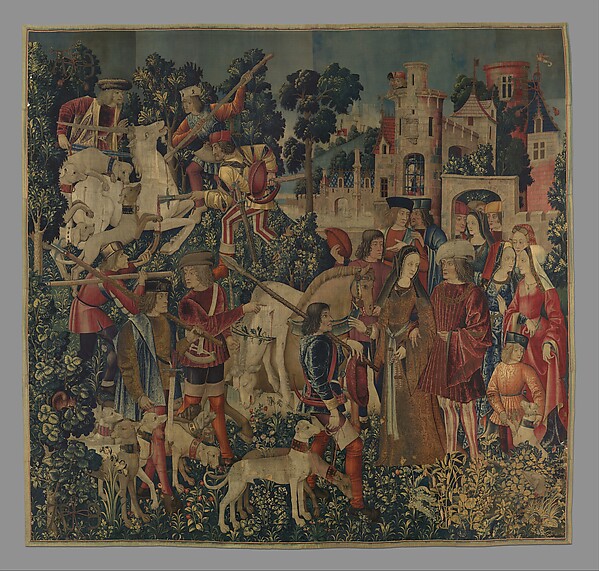
The Unicorn Is Killed and Brought to the Castle
Examine the Hunt tapestry's solemn procession, where the slain unicorn is carried to a castle and the chase becomes a public ceremony.
Reviewed and updated
- Museum title
- The Unicorn Is Killed and Brought to the Castle
- Date
- 1495–1505
- Narrative moment
- The hunt returns to court
- Collection
- The Metropolitan Museum of Art
The Unicorn Is Killed and Brought to the Castle turns the hunt into a procession. The unicorn’s body is carried back toward an inhabited, socially ordered setting, while people gather to witness the result. The chase is over, but the tapestry does not treat death as a private endpoint. It becomes a public display involving hunters, attendants, and figures associated with the castle.
This shift from woodland struggle to ceremony is crucial. It shows that the hunt concerns more than physical pursuit: it is also about hierarchy, possession, reputation, and the presentation of a rare quarry.
What is happening in the tapestry?
The dead unicorn is transported by the returning party. Its pale body remains visually prominent even though it no longer controls the action. The surrounding figures organize its movement toward the castle and transform the animal into the focus of a social event.
The composition contains more than one phase of action. The hunting party advances, observers respond, and architectural elements identify a destination. As in the other Hunt tapestries, the eye is encouraged to travel through the scene rather than settle immediately on a single emblem.
The familiar shortened title “Brought to the Castle” can soften what is represented. The museum’s fuller title—The Unicorn Is Killed and Brought to the Castle—keeps the animal’s death visible and clarifies why the procession carries such weight.
From pursuit to possession
During the chase, hunters struggle to reach and control the unicorn. In the procession, they have apparently succeeded. The animal can now be transported, shown, and incorporated into courtly ceremony.
That transformation resembles the social function of an elite hunt. A quarry’s value did not end at the moment of capture or death. The return could demonstrate skill, authority, hospitality, and command over land and animals. Representing the event in an exceptionally expensive tapestry added another layer of prestige.
Yet the unicorn is not ordinary game. The preceding fountain and maiden scenes have established its marvelous qualities. Carrying it toward a castle can therefore be read as triumph, tragedy, sacrifice, or some combination of all three.
How the composition becomes ceremonial
Compared with the attack scenes, movement here is more directional and organized. The figures form a procession rather than a knot of conflict. Architecture provides a stable destination, and the unicorn’s body creates a long, pale shape around which the group is arranged.
Look for contrasts between participants and observers. Who performs the labor of carrying or guiding? Who receives, watches, or displays status? Clothing, posture, and position can reveal social distinctions even when the exact identity of each figure is unknown.
The landscape remains richly woven, but it no longer conceals the quarry. Earlier vegetation screened hunters at the fountain and complicated the chase. Here, the group presents the unicorn openly.
Death, possession, and courtly meaning
The return to the castle belongs visibly to the social world of aristocratic hunting, conquest, and display. It converts the unicorn from a resisting animal into an object around which human rank is performed. That transformation can be read as triumph, but the animal’s pale body and the ceremony surrounding it also make the victory uncomfortable.
Love and marriage have provided another historical framework for the hunt: pursuit ends in possession, while the later enclosed unicorn complicates whether that possession is forced or accepted. The procession can therefore sustain courtly entertainment, dynastic identity, moral unease, and admiration of craftsmanship without requiring one final explanation.
Details that reward close viewing
Start with the unicorn’s body and follow the lines created by its position. Notice how nearby figures support, frame, or look toward it. Then move outward to the architecture and ask how the castle changes the scene’s scale.
Costume deserves careful attention. Differences in fabric, color, headwear, and stance help articulate rank and role. Metal-wrapped and silk threads originally gave selected details a changing brilliance, making the ceremonial aspects more vivid in candlelight or daylight.
Finally, compare human expressions and gestures. The image’s meaning does not come only from the unicorn. The responses around it tell us how the event is being socially understood.
Is this the end of the story?
Narratively, the unicorn’s death might seem final. The famous hanging called The Unicorn in Captivity, however, shows the animal alive inside a flower-filled enclosure. This has encouraged readings based on survival, renewal, love, or willing captivity.
The relationship is not perfectly straightforward. The captivity hanging differs in ways that have led scholars to question whether it originally occupied the simple final position assigned to it in popular retellings. The surviving group has a complicated material history, and its original arrangement is not fully documented.
That uncertainty makes the procession more—not less—interesting. It presents a clear death without guaranteeing how the first audience connected that death to the living unicorn in the garden.
Continue to The Unicorn in Captivity for the cycle’s most famous puzzle, or consult the complete Hunt guide.