The Metropolitan Museum of Art, Open Access · CC0 / The Met Open Access
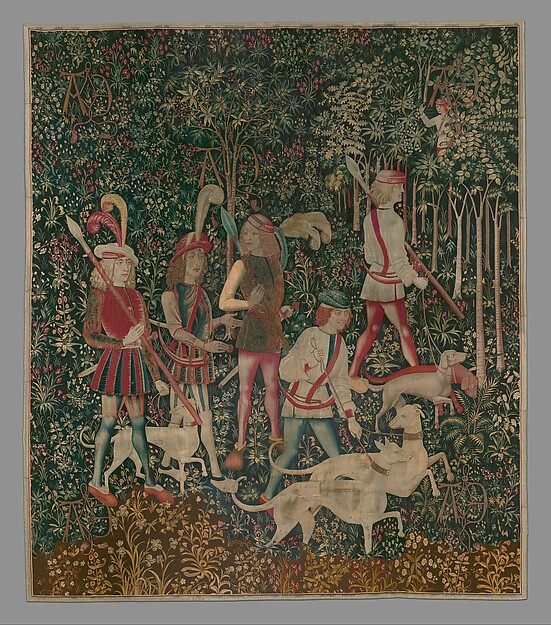
The Start of the Hunt: Opening the Unicorn Tapestry Story
Look closely at The Start of the Hunt, from its gathering hunters and hounds to the visual clues that introduce the Unicorn Tapestries.
Reviewed and updated
- Conventional title
- The Start of the Hunt
- Date
- 1495–1505
- Materials
- Wool warp with wool, silk, silver, and gilt wefts
- Collection
- The Metropolitan Museum of Art
The Start of the Hunt introduces the world of the Unicorn Tapestries before the unicorn appears. Hunters assemble with horses, hounds, attendants, and equipment at the edge of a densely planted landscape. The scene is less a single dramatic event than a carefully staged departure. It tells us who is taking part, how a noble hunt is organized, and where the story is about to go.
The hanging was woven in the South Netherlandish tapestry tradition around 1495–1505. Like the other works associated with the Hunt of the Unicorn, it combines durable wool with silk and precious-metal threads. Those materials once made highlights on clothing and equipment catch the light as viewers moved through a room.
What is happening in the scene?
The hunters have not yet found their quarry. Instead, people and animals prepare to move from an ordered human setting into the wooded territory of the hunt. Some figures confer while others manage horses or dogs. The hounds are especially important: their bodies, leashes, and alert heads create movement before the main pursuit begins.
This beginning would have been recognizable to an aristocratic audience. Hunting was not simply an improvised chase. It involved specialized roles, trained animals, social hierarchy, and ceremony. The tapestry uses those preparations to establish the hunt as both an outdoor activity and a display of status.
Because the unicorn is absent, the viewer initially shares the hunters’ uncertainty. We know what they seek only from the larger cycle and its later scenes. That delayed appearance gives the opening its sense of expectation.
How the composition starts the story
The image directs attention through gestures, glances, animals, and overlapping figures. Hounds point toward the landscape. Riders and attendants form a loose procession. Vertical tree trunks and the denser vegetation ahead mark a threshold between gathering and pursuit.
The ground is filled with carefully differentiated plants rather than treated as an empty stage. This kind of botanical richness appears throughout the series. It creates a convincing habitat while also showing what a highly skilled weaving workshop could achieve with small changes of colored thread.
Look at the scene in three passes:
- From a distance, notice how the people and horses form groups.
- At middle range, follow the direction of leashes, bodies, and gazes.
- Up close, compare clothing, equipment, dogs, and plants.
That progression—from social order to tiny natural detail—prepares the way the later tapestries ask to be viewed.
Why begin without the unicorn?
An opening scene needs to create a normal world before something extraordinary interrupts it. Here, the normal world is the elite hunt. The unicorn’s later appearance at the fountain becomes more powerful because the first hanging establishes experienced hunters using familiar methods. Their quarry, however, will not behave like an ordinary animal.
The absence also keeps interpretation open. A viewer can first read a courtly expedition, then reconsider it after seeing the violence, capture, and puzzling survival that follow. Christian and courtly interpretations of the full cycle are easier to understand when we remember that the narrative begins with human intention rather than with an explanatory religious emblem.
Details worth examining
Pay attention to differences among the hounds rather than reading them as a repeated decorative pattern. Notice which figures work, which command, and which observe. Clothing and posture help establish rank, while the crowded arrangement turns preparation into visual rhythm.
It is also worth comparing the tapestry’s present colors with the idea of its original appearance. Five centuries of light and environmental exposure inevitably affect textiles. Silk and metal-wrapped threads would have produced contrasts that photographs and modern displays cannot fully recreate.
Place in the surviving cycle
Modern presentations place this hanging at the beginning of the Hunt of the Unicorn. The surviving works do not form an untouched medieval picture book: damage, fragments, and uncertainties complicate their original arrangement. The familiar sequence is nevertheless a useful way to follow the action while keeping those limits in mind.
Continue to The Unicorn Is Found, where the quarry finally appears beside a fountain, or use the complete Hunt of the Unicorn guide to see the whole sequence.