The Metropolitan Museum of Art, Open Access · CC0 / The Met Open Access
The Unicorn Is Found: The Fountain Scene Explained
Explore The Unicorn Is Found tapestry, where hunters discover the unicorn at a fountain surrounded by animals, plants, and layered symbolism.
Reviewed and updated
- Conventional title
- The Unicorn Is Found
- Date
- 1495–1505
- Central motif
- The unicorn at a fountain
- Collection
- The Metropolitan Museum of Art
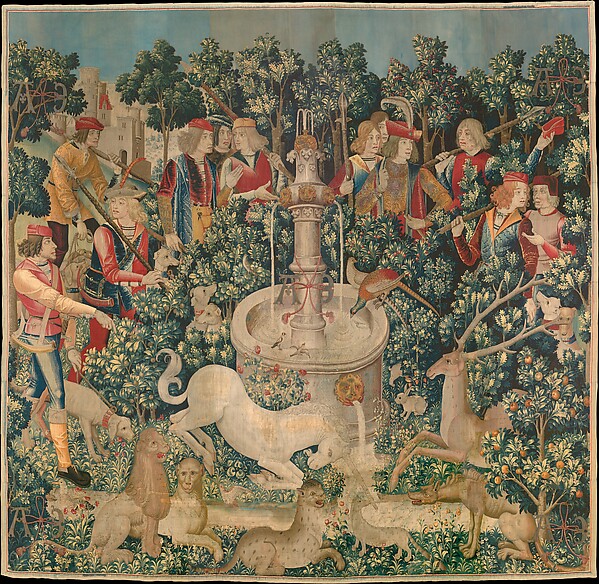
In The Unicorn Is Found, the quarry appears at the center of an unusually crowded gathering. The unicorn lowers its horn toward the water of a fountain while animals wait nearby and hunters watch from the edge of the scene. Discovery has occurred, but pursuit has not yet broken the strange stillness around the water.
The fountain makes this one of the most symbolically rich images in the Hunt of the Unicorn. It joins a familiar medieval story about the unicorn’s horn with close observation of animals and plants. At the same time, the concealed hunters remind us that the peaceful gathering is about to become dangerous.
What is happening at the fountain?
Medieval and early modern traditions credited the unicorn’s horn—often identified in real collections with the tusk of a narwhal—with the power to detect or counteract poison. In versions of the fountain legend, other animals wait while the unicorn purifies contaminated water. The tapestry appears to draw on that tradition: the unicorn’s horn touches or approaches the flowing water as a remarkable variety of creatures gathers around it.
The hunters occupy a different visual world. Partly screened by vegetation, they observe rather than participate. Their position lets the viewer experience two events at once: an almost ceremonial animal assembly and the instant when human pursuers locate their target.
This is not a scientifically literal wildlife scene. Animals that would not calmly gather together are organized around the fountain to create a compact visual catalogue. Their differences in scale, coat, posture, and species provided the weavers with opportunities for extraordinary detail.
How the composition controls attention
The fountain provides a strong vertical and central anchor. Water moves through its structure while the animals form a broad ring around it. The pale body of the unicorn stands apart from darker foliage, yet it remains connected to the surrounding creatures through heads, backs, and lines of sight.
The hunters are easy to overlook on a first viewing. Once noticed, they change the mood. Follow their gazes toward the unicorn, then trace how branches and leaves partly interrupt that view. The tapestry makes discovery feel like an act of looking through a living screen.
Three kinds of attention overlap:
- The animals attend to the water and unicorn.
- The hunters attend to their quarry.
- The viewer moves between both groups, knowing that the calm cannot last.
Water, healing, and possible meanings
The purifying-horn legend gives the scene an obvious theme of cleansing or protection. It also presents a marvelous creature performing a beneficial act at the center of an elite hunt, which makes the decision to pursue it morally and narratively complicated.
It is safer, however, not to assign a fixed symbolic definition to every animal or plant. The fountain has narrative and legendary importance, but the tapestry also celebrates variety, skilled observation, and costly workmanship. Some details may carry associations; others contribute to the convincing abundance of the setting.
Details to look for
Begin with the water. Follow it from the fountain through the lower part of the composition and notice how it divides or links the animals. Compare creatures that drink, watch, or turn away. Then find the hunters and ask how much of each figure the foliage allows you to see.
The plant-filled ground deserves equal attention. Distinct leaves and blossoms break up the dark field and prevent the animal gathering from becoming a single mass. This millefleurs-like richness is not merely background decoration: it controls spacing and rewards close viewing.
Also consider how different the tapestry would have looked when metal-wrapped threads and silk retained more of their original sheen. The fountain and fine costume details would respond to changing interior light, adding movement to a scene that is narratively suspended.
Why this scene matters to the cycle
This is the first clear encounter between the hunters and the unicorn. The animal is shown performing a beneficial or wondrous act, not threatening anyone. That choice makes the violence of the subsequent pursuit harder to treat as a simple contest between hunters and dangerous prey.
The fountain scene therefore establishes the unicorn as exceptional before the chase tests its strength. It also introduces one of the cycle’s central tensions: human desire to possess what is rare, beneficial, wild, or seemingly beyond ordinary control.
Continue to The Unicorn Is Attacked or return to the Hunt of the Unicorn overview for the complete surviving sequence.