The Metropolitan Museum of Art, Open Access · CC0 / The Met Open Access
The Unicorn Defends Itself: Resistance in the Hunt Tapestries
A close reading of The Unicorn Defends Itself, including its compressed action, powerful central animal, and place in the Hunt of the Unicorn.
Reviewed and updated
- Conventional title
- The Unicorn Defends Itself
- Date
- 1495–1505
- Central theme
- The quarry resists
- Collection
- The Metropolitan Museum of Art
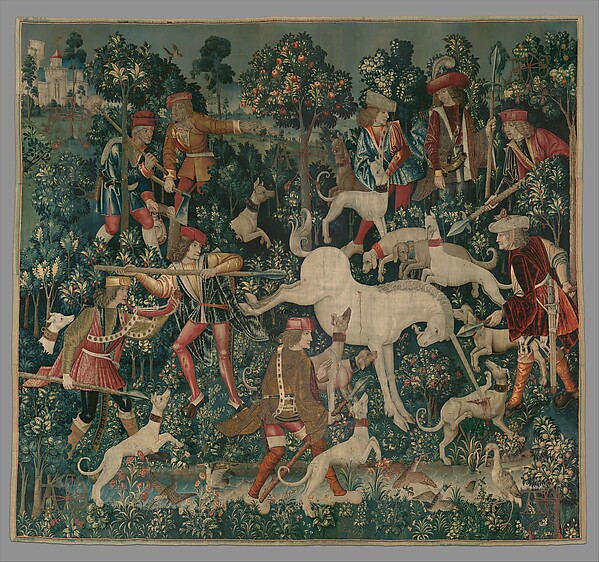
In The Unicorn Defends Itself, the pursued animal becomes the scene’s most forceful actor. The hunters and hounds have closed in, but the unicorn twists into resistance rather than submitting. The tapestry compresses bodies, weapons, branches, and gestures around that struggle, creating a difficult image that demands more than a decorative glance.
This moment is essential to the Hunt of the Unicorn because it establishes the unicorn’s legendary ferocity. Medieval descriptions did not treat it as a gentle horse with a horn. It was wild, swift, and dangerous to capture. The tapestry gives that literary reputation a physical form.
What changes in this panel?
The preceding chase directs most movement toward the unicorn. In the defense scene, force moves in both directions. Hunters and dogs press inward while the unicorn turns against them. That reversal makes the animal an active subject rather than a passive prize.
The effect depends on proximity. There is little empty ground around the central struggle. Figures overlap, and parts of bodies disappear behind other forms. The viewer must reconstruct the action from heads, limbs, weapons, and lines of sight.
This visual difficulty is purposeful. A clear, isolated profile would make the unicorn easy to inspect but would weaken the impression of danger. Compression makes the encounter feel immediate and unstable.
The unicorn as a powerful animal
Modern popular imagery often makes the unicorn harmless, but the older tradition is more complicated. Its single horn is both marvelous and potentially lethal. Its purity or healing associations exist alongside physical independence and resistance to capture.
The tapestry holds those qualities together. The unicorn seen peacefully at the fountain is recognizably the same creature that now fights for survival. This continuity matters: the hunters have chosen to pursue an animal whose extraordinary nature was already established.
Look at the angle of the unicorn’s body and the direction of its horn. Then compare the reactions of nearby humans and dogs. The composition makes the animal’s power visible through the space that others struggle to control.
How order survives inside the violence
Despite its intensity, the hanging is not disorganized. Repeated diagonals bind the action together. Dark and light areas separate important forms. Vegetation fills gaps and prevents the woven surface from breaking into disconnected episodes.
The border and surrounding growth also provide a visual limit. They contain the struggle in much the same way that the hunters attempt to contain the unicorn. This relationship between framing and action is one reason the panel can feel both explosive and carefully designed.
A useful close-looking exercise is to count directional lines:
- Which weapons point toward the unicorn?
- Which animal bodies point away?
- Where do the hunters look?
- Which curves or branches slow your eye?
The answers show how the image balances impact with legibility.
Courtly power and the limits of control
A courtly or aristocratic reading begins with the hunt itself. The panel displays coordinated elite activity while dramatizing the danger that makes capture prestigious. Readings based on love and desire may see pursuit meeting the independence of the beloved. A political reading may instead notice how organized human power fails to produce effortless control.
None of these possibilities should erase the visible violence. Interpretation is strongest when it begins with the bodies represented in the tapestry and then asks what associations a historical viewer might have brought to them.
Materials and original viewing
The hanging’s wool, silk, and metal-wrapped threads would once have produced changes of texture and reflection across the crowded surface. Fine highlights could distinguish equipment, clothing, water, or hair as interior light shifted. Tapestries were architectural objects as well as images: their scale and material presence surrounded viewers in ways that a small reproduction cannot.
Present condition also matters. Colors and delicate fibers change over centuries. Museum display balances public access with the need to protect light-sensitive textiles. The object seen today is both a Renaissance artwork and a survivor with a long material history.
Why this scene is a turning point
The unicorn’s defense proves that force alone cannot make the hunt simple. The next surviving fragments introduce a maiden and a radically different kind of capture. Read through legend or courtly symbolism, the shift suggests that the wild creature can be approached in a way weapons could not accomplish.
Continue to The Mystic Capture of the Unicorn or see where this moment falls in the complete Hunt of the Unicorn sequence.