The Metropolitan Museum of Art, Open Access · CC0 / The Met Open Access
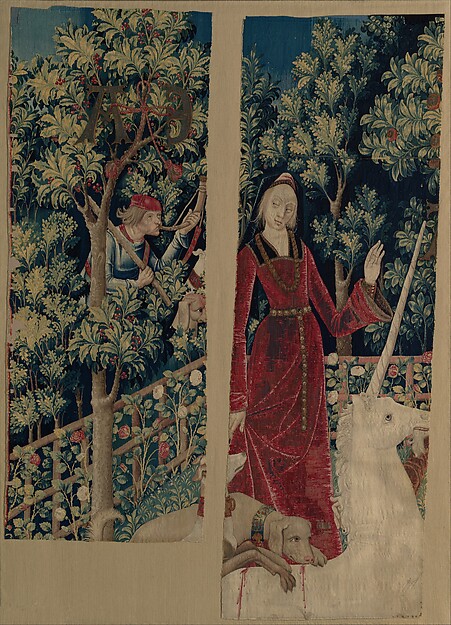
The Mystic Capture of the Unicorn: What the Fragments Show
Explore the surviving fragments known as The Mystic Capture of the Unicorn and the maiden legend that changes the course of the hunt.
Reviewed and updated
- Museum title
- The Mystic Capture of the Unicorn
- Present form
- Two surviving fragments
- Date
- 1495–1505
- Collection
- The Metropolitan Museum of Art
The work commonly called The Mystic Capture of the Unicorn survives not as a complete rectangular hanging but as two damaged fragments. Even in that incomplete state, it marks a striking change in the Hunt of the Unicorn. Weapons and hounds no longer provide the only means of approaching the animal. A maiden enters the story, drawing on the old belief that a unicorn too fierce to be taken by hunters could become gentle in the presence of a virgin.
The missing portions matter. We should not imagine that every detail of the original scene can be reconstructed with certainty. The fragments preserve enough to connect the image with the maiden-and-unicorn tradition, but damage limits what can responsibly be said about its original composition and precise relationship to the other hangings.
What survives?
The two pieces preserve separated parts of what was once a larger scene. Their cut and damaged edges immediately distinguish this work from the more complete tapestries in the group. Figures and landscape continue beyond the surviving cloth, reminding viewers that they are looking at remnants rather than a deliberately divided diptych.
The maiden and unicorn provide the scene’s central interpretive relationship. After the violence of the attack and defense hangings, their proximity creates an abrupt stillness. The animal that resisted armed pursuit can now be approached through a different legendary condition.
When viewing the fragments, begin at the incomplete edges. Ask which bodies, plants, or lines once continued into lost areas. This reverses the usual museum habit of treating a framed object as visually self-contained and makes the history of damage part of the encounter.
The maiden-and-unicorn legend
Medieval bestiaries and related traditions described a method of capturing the unicorn through a maiden. Details vary among texts and images, but the basic contrast is consistent: hunters cannot overcome the animal through ordinary force, while its behavior changes near her.
In secular and courtly settings, the encounter could carry ideas about love, desire, attraction, self-command, trust, or the taming of wildness. The tapestry participates in this broad legendary tradition without functioning as a simple diagram of one surviving text. Its expensive materials and place within an elite hunting narrative make the social change—from armed force to quiet proximity—especially important.
Why “mystic capture” is a useful but interpretive title
Modern titles help museums and viewers identify scenes, but they are not always original labels supplied by a tapestry’s makers. “Mystic Capture” emphasizes the legendary and symbolic nature of the event. It also distinguishes this moment from capture achieved by physical attack.
The term should not encourage false certainty. We do not know exactly how the first owners named the scene or arranged every surviving hanging. The fragments’ relation to the Hunt group has also generated scholarly discussion. It is best to use the familiar title while recognizing that it frames our interpretation.
A composition transformed by loss
Damage changes how the scene works. In a complete narrative tapestry, borders and figures guide the eye through an organized field. Here, missing cloth interrupts those routes. The viewer moves between preserved islands of action and mentally supplies absent space.
That condition has historical value of its own. Large textiles were vulnerable to cutting, changing interiors, neglect, light, moisture, and shifts in taste. Survival is rarely neutral. The fragments show both Renaissance weaving skill and the later history through which the object reached the museum.
Look closely at what remains of the vegetation and costume. Even partial passages demonstrate the workshop’s control of color and contour. Silk and metal-wrapped threads originally added changes of sheen that would have become visible as people walked past the hanging.
How the scene changes the hunt
The fragments interrupt a story dominated by coordinated male hunters and trained hounds. The maiden introduces another kind of power—quiet, ambiguous, and rooted in legend. The unicorn’s apparent gentleness may suggest trust, surrender, destiny, or vulnerability depending on the interpretive framework.
This does not erase the violence surrounding the episode. In the conventional sequence, the animal will be killed and carried toward a castle. The maiden scene can therefore feel peaceful and ominous at the same time. Its stillness enables capture rather than guaranteeing safety.
Questions to keep open
A responsible reading should preserve several uncertainties:
- How much of the original composition is lost?
- Was the scene designed for exactly the sequence now used in displays?
- Which courtly, legendary, or social associations mattered most to its first audience?
- How did its incomplete survival alter later interpretations?
Those questions do not weaken the work. They distinguish close historical study from a modern retelling that fills every gap.
Continue to The Unicorn Is Killed and Brought to the Castle, or return to the Hunt of the Unicorn overview for the sequence and its uncertainties.