The Metropolitan Museum of Art, Open Access · CC0 / The Met Open Access
The Unicorn Is Attacked: Reading the Chase Across the Stream
Examine The Unicorn Is Attacked tapestry, where the fountain's stillness gives way to hounds, hunters, water, and a tightly organized chase.
Reviewed and updated
- Conventional title
- The Unicorn Is Attacked
- Date
- 1495–1505
- Narrative moment
- The pursuit begins
- Collection
- The Metropolitan Museum of Art
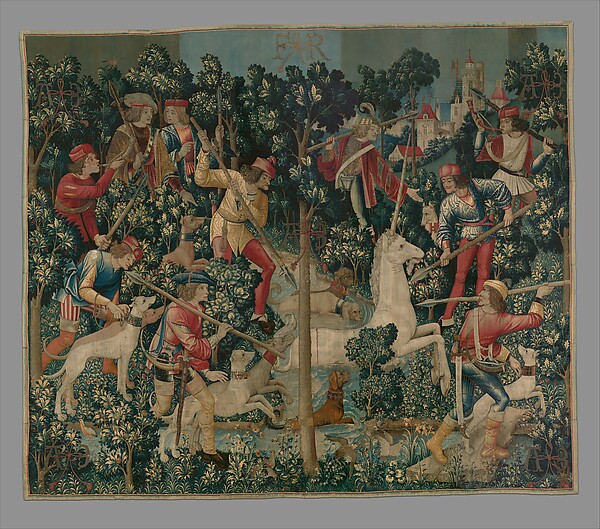
The Unicorn Is Attacked replaces the suspended calm of the fountain with pursuit. Hunters and hounds close in as the unicorn moves through water and dense vegetation. Bodies overlap, weapons and leashes create diagonals, and the landscape becomes part of the chase rather than a setting observed at leisure.
The tapestry demonstrates how a still woven surface can produce urgency. Nothing literally moves, yet almost every major line directs the eye across or toward the unicorn. The result is one of the surviving cycle’s clearest transitions from discovery to conflict.
From fountain to pursuit
In the preceding hanging, animals gather while hunters watch. Here, observation has become action. The hounds have entered the chase, and the unicorn’s body registers the pressure around it. Water marks both an obstacle and a route through the landscape.
A stream is particularly useful for visual storytelling. Its changing edge breaks up the ground, while reflections and ripples give weavers another way to suggest movement. The unicorn’s passage across it separates the animal from some pursuers even as the overall composition closes around it.
The hunters do not form one simple row. Their positions and gestures create several moments within the same image: pursuit, attack, reaction, and coordination. A viewer can therefore read the tapestry gradually, almost as if the action unfolds while the eye travels across the cloth.
How the tapestry creates speed
Several devices make the scene feel rapid:
- Diagonals: weapons, leashes, limbs, and sloping bodies resist the calm stability of vertical lines.
- Overlap: figures partly hide one another, suggesting a crowd moving through limited space.
- Repetition: the bodies of hounds form a visual sequence that carries the eye forward.
- Contrast: the unicorn’s pale coat remains legible against the darker plants and water.
Notice that detail does not disappear when the action intensifies. Leaves, flowers, clothing, and animals remain carefully articulated. The weavers had to balance narrative clarity with the surface richness expected of a prestigious tapestry.
The role of the hounds
The dogs are not interchangeable decoration. In a hunt, trained hounds locate, pursue, and hold attention on the quarry. In the tapestry, their repeated bodies translate that function into visual rhythm. Some stretch forward, others turn or cluster, and their direction helps the viewer understand where the chase has come from and where it is going.
Looking closely at the hounds also changes the emotional tone. The scene is not an abstract symbol of “pursuit”; it is a physical encounter involving vulnerable animal bodies. That directness becomes even more important in the next hanging, where the unicorn fights back.
Landscape as an active participant
The stream, banks, and thick growth do more than identify an outdoor location. They divide the pursuers, conceal parts of bodies, and make the unicorn’s path difficult. The natural world that appeared abundant and almost harmonious around the fountain now becomes contested ground.
This change is worth comparing across the cycle. The same visual language of plants and water can support calm in one scene and danger in another. Meaning comes not from a flower or tree in isolation but from how the whole composition organizes attention and action.
How should the attack be interpreted?
The scene can be understood first as a courtly hunt represented with unusual richness. It may emphasize pursuit, desire, conquest, elite coordination, or the dangers of trying to possess an animal defined by its independence.
No surviving caption inside the tapestry tells viewers to choose one explanation. The strongest interpretations account for what is visible: the unicorn under pressure, coordinated hunters, forceful hounds, and difficult terrain. The scene’s social and emotional tensions are already present in those details.
A close-looking method
Find the unicorn first, then deliberately look away from it. Identify the figure or animal farthest from the center and trace the route back through repeated lines. Next, follow the water instead of the hunters. Finally, compare each hound’s pose.
This method reveals that the composition is not chaotic. Its density is highly controlled. The eye may feel swept into the chase, but carefully placed forms determine that experience.
Continue to The Unicorn Defends Itself, where pursuit meets violent resistance, or return to the complete Hunt guide.