Wikimedia Commons · Public Domain
_L%27Ou%C3%AFe_(La_Dame_%C3%A0_la_licorne)_-_Mus%C3%A9e_de_Cluny_Paris.jpg)
Hearing in The Lady and the Unicorn Tapestries
Explore the Hearing tapestry, where the lady plays a portable organ with an attendant and music becomes a courtly, collaborative performance.
Reviewed and updated
- Traditional sense
- Hearing
- Date
- Around 1500
- Key detail
- A portable organ played by two women
- Collection
- Musée de Cluny, Paris
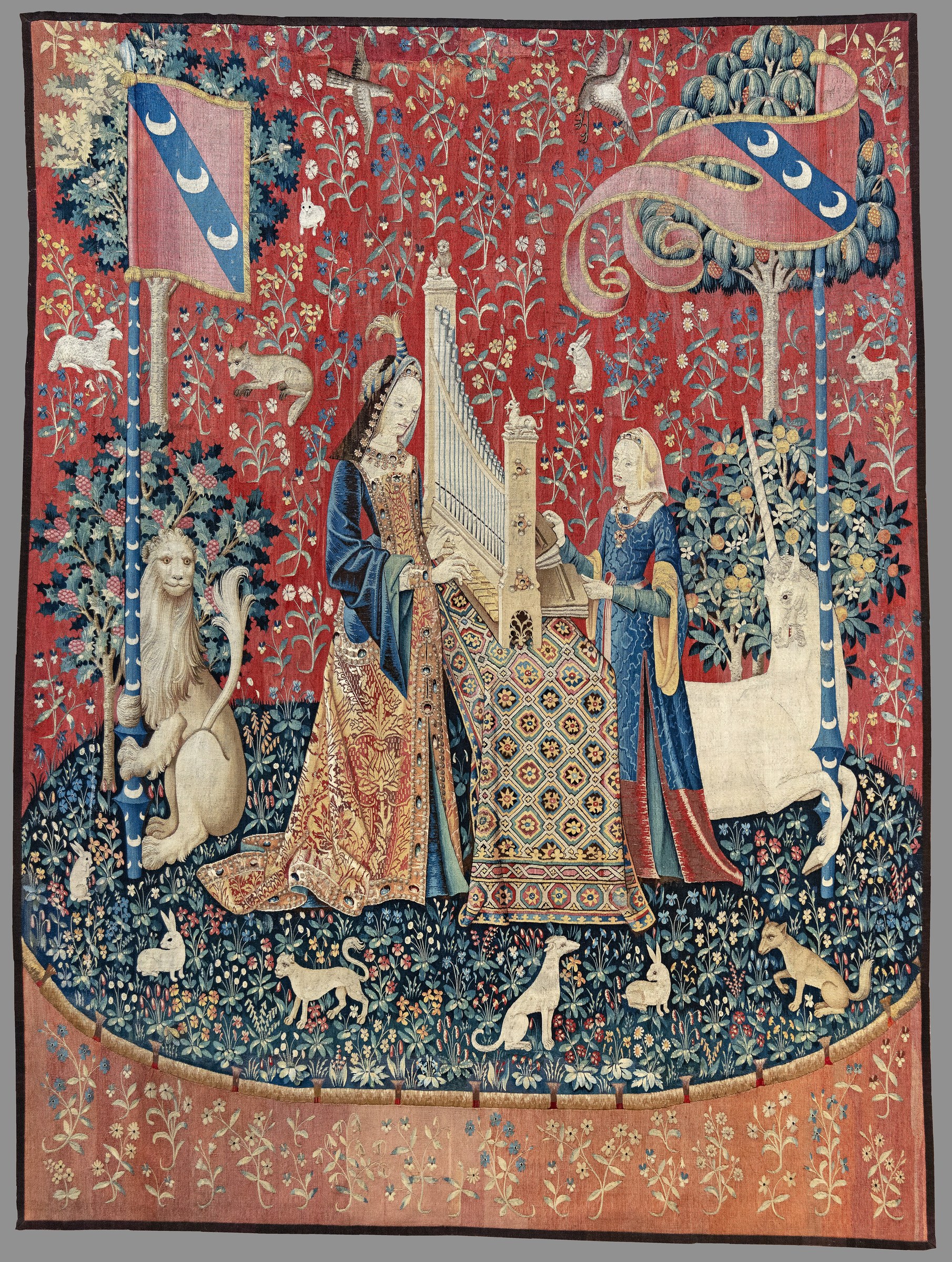
The tapestry traditionally identified as Hearing makes sound visible through cooperation. The lady sits at a small portable organ, her hands on the keys, while an attendant operates the bellows behind the instrument. The lion and unicorn raise their banners on either side, and the usual flower-filled field surrounds the scene.
Music cannot be heard from the tapestry, but the image gives it a structure: hands, keys, bellows, posture, and shared timing. Hearing is not represented as a passive ear receiving noise. It is an act of performance requiring attention, knowledge, and another person’s labor.
The portable organ
The instrument at the center is a small organ that needs air supplied by bellows. The lady plays the keyboard while the attendant keeps the instrument sounding. Their paired actions are essential. One figure cannot create the music alone.
This practical detail makes Hearing one of the most active panels in the set. Its action remains calm, but it depends on coordination. The attendant bends toward the bellows; the lady’s body is arranged around the keys; the instrument itself joins their two positions into one composition.
The organ also identifies the setting as elite. Musical instruments, trained performance, attendants, and fine dress belong to a world in which hearing is associated with cultivated accomplishment rather than accidental sound.
How the image creates a sense of sound
The tapestry uses repetition and balance to suggest rhythm. Vertical elements of the organ, the raised banner poles, and the central figures establish a measured structure. Curves in costume and bodies soften that order, preventing the scene from feeling mechanical.
Start with the lady’s hands and follow the implied movement to the keys. Then move backward to the attendant and the bellows. The eye travels through the image in the same way the sound depends on a chain of actions: air, instrument, touch, and listening.
The lion and unicorn do not play, but their placement creates a ceremonial audience. They frame the musical event and make the act of hearing part of the series’ heraldic and social order.
Hearing as a courtly virtue
Late medieval and Renaissance culture often treated music as both pleasure and discipline. It could express harmony in the body, household, court, or cosmos. A well-performed piece demanded training, memory, coordination, and control.
The lady’s composed posture matters in this context. She is not simply enjoying a tune; she appears as the centered performer within a carefully regulated scene. The attendant’s contribution makes visible the service and collaboration that support courtly display.
Religious associations are also possible. Music had a place in devotion and in ideas of heavenly harmony. But the tapestry offers no inscription telling us to read the scene as sacred. Its strongest immediate meaning is the refinement of making music together.
Look beyond the organ
The central instrument provides the title, but the surrounding details prevent the panel from becoming an illustration in a textbook. Notice the changing expressions and poses of the lion and unicorn. Compare their banners with the fabrics of the lady’s clothing. Search the red field for birds, animals, and flowers that create a second, quieter rhythm around the musical group.
The blue island beneath the figures acts as a stage. It separates the performance from the red millefleurs field while still allowing plants and animals to connect the spaces. The cycle repeatedly plays with this relation between a formal central island and a lively ornamental world.
Tapestry material deepens the effect. Wool provides the broad color fields, while silk could create subtle luster on clothing and details. A performance scene made of changing threads responds to light as viewers move, adding a visual counterpart to the changing duration of music.
Hearing and the other senses
Hearing is one of the clearest sensory identifications in the series because the organ is unmistakable. Yet it also complicates the idea of a simple one-sense program. Music is made with touch, coordinated through sight, and experienced by more than one person. The set’s panels are distinct, but they are not isolated from one another.
Compare Hearing with Sight, where looking becomes an intimate exchange through a mirror, or with Taste, where a small object organizes a different kind of courtly action.
For the full context, return to The Lady and the Unicorn tapestries.